Carl Kennedy, director of JL Audio's Home and Professional Sales division, leaned forward and quietly asked, "Would you like to review our Fathom f113 subwoofer?"
We were standing in JL Audio's exhibit area at the 2007 Consumer Electronics Show, near a mob surrounding a display of an "exploded" f113. The sub's 13.5" cone had been pulled apart, and its huge magnet assembly, voice-coil, spider, internal amplifier, and control panel were suspended in air.
I nodded enthusiastic agreement.
"What would you think if I asked you to review a pair of f113s?"
"Let's do it!" But suddenly I was nervous about the prospect of lifting two slippery, 130-lb subwoofers. Why two?
I was visiting JL Audio's exhibit because of the praise Kal Rubinson had heaped on the Fathom f113 ($3400) in his "Music in the Round" columns of November 2006 (Vol.29 No.11) and May 2007 (Vol.30 No.5), particularly its built-in Automatic Room Optimization (ARO) function. For optimal response, a subwoofer's output should be placed in the spot that cancels out the most troublesome room modes. If that's not possible, then a subwoofer that can automatically and reliably achieve the same result by retuning itself would greatly simplify installation. Other subwoofers I have reviewed—including the Velodyne DD-18 (June 2004, Vol.27 No.6), REL Studio III (October 2004, Vol.27 No.10), and Revel Ultima Sub-30 (November 2004, Vol.27 No.11)—provide test tones and equalizer controls, but require the owner to interpret the findings and then manually make the appropriate adjustments. At the 2003 CES, Intelligent Audio presented a "concept" subwoofer system, the 1A-643 ($11,700), that could, for any room, automatically adjust the sub's directivity, crossover filter characteristics, and boundary equalization (May 2003, Vol.26 No.5, p.52). However, IA has yet to manufacture the 1A-643.
Sensing my hesitation, Kennedy explained that "Floyd Toole's work suggests that running multiple subs in one room can have beneficial effects on the room's modal response and create a larger useful listening area."
"Really? Why would two subs smooth the room response?"
"Their combined output can suppress room-mode interactions at your listening seat that would normally show up if each sub were tested independently."
Description
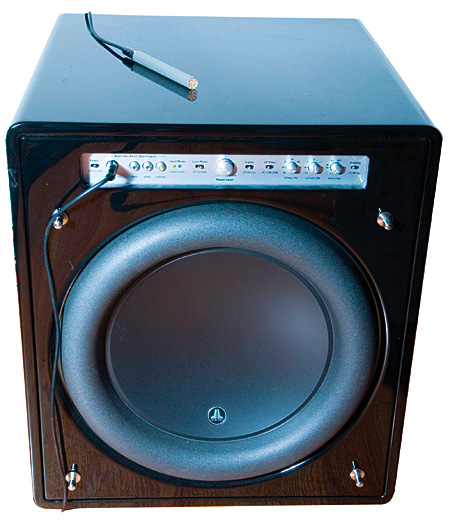
JL Audio started by making subwoofers exclusively for cars and boats. This may explain why their new models intended for domestic use, like the Fathom f113, are so rugged. Though nominally smaller, the f113 outweighs my Velodyne DD-18 subwoofer, with its 18" cone, by 7 lbs. More remarkable are the 4" peak–peak excursions of the f113's 13.5" woofer cone, driven by a 2.5kW class-D amplifier. To handle the internal forces, the f113's sealed enclosure is constructed of 1"-thick MDF and reinforced with two donut braces parallel to the front baffle.

The f113 brochure explains how the 13.5" cone maintains control during its huge excursions through a series of proprietary JL Audio technologies: The motor system has been designed to maintain a stable magnetic field over a wide power range; an expanded OverRoll rubber surround spans the driver's mounting flange; the Floating-Cone Attach Method of assembly ensures the proper surround geometry, to maintain voice-coil alignment at all sound levels; the W-Cone construction is said to provide torsional rigidity with minimal mass to maintain voice-coil alignment at the excursion limits; the Plateau-Reinforced Spider Attachment technique relieves stress on the spider material during peak excursions; the Elevated Frame Cooling Technology delivers cool air to the voice-coil to minimize power compression from overheating; and the Radially Cross-Drilled Pole Piece venting design increases thermal dissipation by directing a flow of air to the voice-coil former.
Other features include a front-facing control panel, a ground-lift switch to eliminate system hum pickup, and an optical interface between the unbalanced input jacks and the amplifier, also to prevent hum.
Like the Genelec HTS4B subwoofer, which I reviewed in November 2005 (Vol.28 No.11), the Fathom f113 doesn't have a high-pass filter to roll-off the bass response of the satellite speakers. This is because all surround-sound processors and receivers provide the high-pass filtration and bass management before the signal reaches the sub.
Controls in front, plugs in back
The Fathom f113's controls are arrayed on its brushed-aluminum front panel, just under the removable grille. Adjustments can thus be made without having to turn the 130-lb subwoofer around, or bend over it and figure out switch locations and settings from above. Some switches are standard: a Power switch with On, Off, and Auto Sensing positions; a Level control; and a Polarity toggle (0°/180°). The Phase control continuously adjusts phase from 0° to 280°. The Low Pass Filter Frequency control adjusts the low-pass filter point between 30 and 130Hz, and the Extremely Low Frequency Trim knob adjusts the slope of a 25Hz filter to damp any troublesome interactions the room might have with the f113 at extreme low frequencies.
The ARO calibration mike plugs into a front-panel jack, next to which are three buttons: Demo verifies the ARO functions with a 20-second sequence of demonstration tones; Defeat turns off the ARO calibration system to compare the ARO and non-ARO settings; and Calibrate initiates the ARO test tones to measure the room response and activate the automatic equalization routine.
All set-and-forget inputs are on the f113's rear panel, including two XLR connectors—one for signal input, the other to link out to a slave f113—and a pair of line-level RCA input jacks. At the bottom of the rear panel are the Master/Slave Mode selector switch, an input grounding mode switch, and an IEC socket for the detachable power cord. The class-D amplifier is attached to the inside of this panel, its rows of heatsinks lining the back.
The Fathom f113's fit'n'finish are professional and neat, and its veneer of glossy black lacquer is the equal of the most expensive audiophile subs I've reviewed for Stereophile. The hardware and connections are rugged, easily accessible, and look as if they'll last for years.
Setting up two Fathom f113s
Setup began when 345 lbs of Fathom f113s in their crates arrived at my door, the two cartons strapped to a huge shipping pallet. A bright orange unpacking sheet warned: "Due to the weight of the Fathom subwoofer, please exercise caution while unpacking and positioning it to prevent injury. If possible, enlist the help of a second person to facilitate the process. To minimize the risk of injury, bend your knees and lift with your legs, not your back."
Heeding this warning, I unpacked the f113s and "walked" them, one at a time, up the short flight of carpeted stairs to my listening room. I used my leg muscles to gently roll each one end over end, cloth covers securely fastened to protect its finish. Fifteen minutes later, both units sat undamaged in my listening room. After laying old towels under the f113s to protect my wood floors, I slid each sub behind one of my Quad ESL-989 speakers until there was one near each front corner of the room. The Quads were 5' from the front wall, 8' apart, 3' from the sidewalls, and slightly toed-in toward my listening chair. They were driven by Bryston 28B-SST monoblocks, whose 1kW output seemed enough to drive any speaker to good volumes in my 4056-cubic-foot, lightly damped listening room. (The room is 26' long by 13' wide by 12' high and opens onto a 25' by 15' by 8' kitchen.)
Following the directions in the JL manual, I connected the subs in Master/Slave configuration by setting the right f113 to Master, the left to Slave. Both will then reproduce the same bass signal. The full-range audio signal from my Krell KCT preamplifier was fed to a Bryston 10B-SUB electronic crossover via a pair of balanced interconnects (see reviews of the 10B-SUB in Stereophile, May 1994, Vol.17 No.5; and November 2005, Vol.28 No.11). I set the 10B-SUB to provide a summed R+L mono signal at its bass outputs, its right and left high-pass filter switches to 100Hz (18dB/octave), and its left channel's low-pass filter to 70Hz (18dB/octave). A short pair of balanced interconnects was run from the 10B-SUB's high outputs to the Bryston 28B-SSTs, which then drove the Quad ESL-989s. The crossover's left low-pass output was connected via a single balanced interconnect to the Master f113's input, this in turn connected to the Slave f113 by another long balanced interconnect. This passed a mono bass signal that incorporated all the Master's settings.
Matching levels: the Quads and the Fathom f113s
Installing two Fathom f113s in my system took a lot more time and careful listening than I'd anticipated. I had to adjust 10 controls on the Master f113, and 10 on the Bryston 10B-SUB electronic crossover. Once I'd listened to the two f113s in the dual-mono Master/Slave configuration, I repeated all setup steps with the two subs configured for stereo operation. For this I used two sets of tools: the signal generator, virtual spectrum analyzer, and microphone built into the Velodyne DD-18 sub; and JL Audio's own ARO system and mike. The Velodyne setup tools allowed me to match the f113s' output to those of the Quad ESL-989s. Though of course not part of JL Audio's installation package, the Velodyne system sure was helpful in completing the f113s' setup. (See my review of the Velodyne DD-18 in the June 2004 Stereophile, Vol.27 No.6, p.133.)
The Velodyne display system generates a sweep signal from 20 to 200Hz. Its own calibration mike captures the speakers' output and displays it on a video monitor. I placed the mike on the back of my listening chair at my seated ear height of 37" above the floor, and set the DD-18's volume control to "0" so that it would output no sound. I then keyed the Velodyne's remote to display its System Response screen on my TV monitor. This automatically triggered a repeated sweep tone from the DD-18's signal generator, which was fed by a long, single-ended interconnect to my Krell preamplifier.
The Quads, driven without the f113s, showed a dip at 60Hz and peaks at 70 and 40Hz, the response falling off 10dB by 35Hz (fig.1). I then ran the same sweep sequence on the pair of f113s alone, which revealed a peak at 50Hz (fig.2).

Fig.1 Quad ESL-989 frequency output, 20–200Hz, no subwoofer, in-room response (25dB vertical range).

Fig.2 JL Audio Fathom f113, uncorrected output, in-room response (25dB vertical range). Note 50Hz peak.
To match levels among the speakers, I first set the right, Master f113's level at 12 o'clock, and the left, Slave unit to Reference. This produced excessive levels of bass output. To correct this, I adjusted the Master sub's level control to 9 o'clock, which produced clean bass-drum strokes without overhang on "Cosmos . . . Old Friend," from the Sneakers soundtrack (CD, Columbia CK 53146). I found that the 0° setting of the Polarity control produced the tightest bass-drum note. I wrote down the switch positions, then turned to the ARO room-EQ procedure.
JL Audio's Automatic Room Optimization
JL Audio's ARO tests the room, then applies single-band equalization to tune out its most prominent deviation from a linear frequency response. JL's manual recommends that the user return all of the f113's controls to their factory default settings before starting ARO. I also shut off my dishwasher and air-conditioner, which produce very-low-frequency artifacts that can hoodwink ARO. I plugged the ARO calibration mike's cable into the Master f113's control panel, punched the Calibrate button, carried the mike to my listening chair, and held it up at ear level.
Within five seconds, the f113 had begun to play rapidly stepped test tones at high volumes. Just as quickly, it stopped and flashed a warning LED to signal that the sub's output was too low to perform the ARO routine. I made several adjustments of the level control, and the 4 o'clock setting proved successful. The stepped test tones were followed by slowly stepped low-frequency test tones and loud ascending sweeps that ran for another two minutes and made every loose object in the room vibrate. The f113's Calibrate light then stayed on continuously, indicating that ARO had been completed. A sweep with the Velodyne DD-18 revealed a smoother room response, with the 50Hz peak reduced (fig.3).

Fig.3 JL Audio Fathom f113 with ARO, in-room response (25dB vertical range). Note that 50Hz peak is flattened.
I unmuted the high-pass section of the Bryston 10B-SUB crossover, returned the Master f113's level control to its 9 o'clock position, and made final adjustments to the electronic crossover settings as I watched the Velodyne sweep signal on my TV. The flattest response for the Master/Slave configuration was achieved when the Bryston 10B-SUB's filter settings were 40Hz low-pass and 100Hz high-pass, the Fathom f113's Extended Low Frequency filter was set to –3dB, and its polarity set to 0° (fig. 4).

Fig.4 Quad ESL-989 output with two JL Audio Fathom f113s after running ARO, in-room response (25dB vertical range).
However, the sound was still not to my liking. In Master/Slave configuration, the f113s activated a powerful room mode when I played the sustained deep organ-pedal tones at the end of a recording of Herbert Howells' Master Tallis's Testament (CD, John Marks Records, advance sample). After consulting with JL Audio, I switched both subwoofers to Master, then set the Bryston crossover's bass output to Stereo and ran each f113 through its own separate ARO procedure. I then set their Extended Low Frequency filter controls to –6dB, to make their frequency-response curve, as displayed by the Velodyne DD-18, fall below 25Hz. Then I reset the Bryston crossover's filters to 40Hz low-pass and 70Hz high-pass.
Voilà! My system now had a more natural deep-bass response with no excitation of room modes, while the soundstage deepened and widened.
Music
Once level-matched and optimized to my room, the two Fathom f113s generated tight, deep, rock-solid bass. Nor did switching in the subs change the pitch, timbre, or quality of my Quad ESL-989s' midrange response. The resulting sound, even at high levels, was free of midbass honk, producing fast, clean, deep bass from recordings of percussion and orchestral music.
Besides the f113s' deep-bass response, what made the biggest impression on me was how two f113s deepened and widened the soundstage, greatly enhancing the Quads' imaging and portrayal of space. The Fathoms enabled the Quads to reveal instruments I hadn't heard before, such as the acoustic guitar that Emmylou Harris softly plays on the last track of Spyboy (CD, Eminent EM 25001-2): a show-stopping, over-the-top rendition of Daniel Lanois's "The Maker." The f113s increased the three-dimensionality of the soundstage, from back to front as well as from side to side. The massive, distorted bass notes on "Deeper Wells," also from Spyboy, had permeated the entire soundstage with other system setups. With the f113s those notes were still as powerful, but now were localized to the front and center of the stage, the drums and vocals behind them.
Other recordings benefited. The f113s added noticeable three-dimensionality to the Quads' reproduction of Barber's voice on Café Blue (CD, Premonition/Blue Note 21810 2), for example.
Another significant change was my system's increased dynamic range. The Quad electrostatics played passages louder, and didn't "clamp off" during passages of wide dynamic range. Supported by the Fathom f113s, the Quads could now handle bass peaks without overloading in my large listening room, most obviously when playing the massive deep synthesizer opening of "Deeper Wells," from Spyboy. Even more impressive was the f113s' ability to resolve the different tonal qualities of percussion instruments—for instance, the synthesizer and pulsatile bass drum in "Silk Road," from I Ching's Of the Marsh and the Moon (CD, Chesky WO144).
The f113s' slam and definition enabled my audio system to produce jaw-dropping dynamic contrasts, enhancing dynamic differences, whether the speakers were driven to lease-breaking levels or playing softly. When I listened to "The Hand-Off," from the Sneakers soundtrack, explosive piano scales jumped out of dead-black silence, sending chills up my spine. John Atkinson's stunning recording of Mark Flynn's kick drum in "Blizzard Limbs," from Attention Screen's Live at Merkin Hall (CD, Stereophile STPH018-2), exploded into the room with a punch I never heard from the Quads on their own.
The f113s enabled the Quads, which otherwise are shy of deep bass, to deliver the intensity and emotional impact of pipe-organ music, as shown best by John Marks' TL-44 Pearl Microphone recording of Howells' Master Tallis's Testament (see "The Fifth Element" in the June 2007 issue). The blend of Quads and Fathom f113s was seamless—all the speakers "disappeared," providing no obvious directional cues to the sources of the crushing, thunderous, tight, deep pedal tones that shuddered the air in my room and rattled any loose objects.
I also heard tight, tuneful bass from older pipe-organ recordings: the deep, rumbling pedal note that ends the selection from Elgar's The Dream of Gerontius on Stereophile's Test CD 2 (CD, STPH004-2); the massive, almost infrasonic note that ends "Lord, Make Me an Instrument," from John Rutter's Requiem (CD, Reference RR-38CD); the rich tapestry of male vocals, delicate harp, and deep, weighty, sustained organ-pedal notes in A Gaelic Blessing, on the same disc; the solid pedal bass mixed with higher, trembling notes in Virgil Fox's performance of Bach's Toccata and Fugue in D Minor (LP, Crystal Clear CCS-7001); and the fullness and air of the 32-foot pedal pipes in Gnomus, from Jean Guillou's transcription for organ of Mussorgsky's Pictures at an Exhibition (CD, Dorian DOR-90117).
The two Fathom f113s had superb pitch definition, making it possible for me to track scales in the pedal notes played by Olivier Latry in the poco adagio section of the first movement of Saint-Saëns' Symphony 3, "Organ" (CD, Ondine ODE 1094-5). KR praised this recording in the May issue (p.40), noting how his Fathom f113 captured the power, richness, and distinctive colorations of the organ's pipes and deep pedal chords.
The Fathom f113s reproduced bass synthesizer notes with great power. In doing so, they added tremendous emotional weight, suspense, and energy to film soundtracks by magnifying ambience and atmosphere. The f113s generated tremendous suspense by mixing the deepest synthesizer growls and surges—they shook the room—with the percussion, chimes, gongs, and snare drums in "Attempt on the Royals," from the Patriot Games soundtrack (CD, RCA 66051-2); the sinister, shuddering, deep-bass chords in "The Carnotaur Attack," from Dinosaur (CD, Walt Disney 50086 06727); the disturbingly deep bass rumblings from the Casper soundtrack (CD, MCA MCAD 11240); the claustrophobic, gut-tightening bass line of "Ain't Yo Bidness," from Insane Clown Posse's The Wraith (CD, RIV 9912-2); and the rumbling synthesizer and deep, otherworldly chants of the Gyuto Monks in "Sand Mandala," from the Kundun soundtrack (CD, Nonesuch 79460-2).
The f113s delivered both the quality and quantity of the deepest bass notes with startling authority. I heard, better than ever before, the massive, surging bass drum and timpani in Stravinsky's The Rite of Spring, performed by the Minnesota Orchestra under Eiji Oue (CD, Reference RR-70CD): they were well-defined, tight, and musical. When I played David Hudson's Didgeridoo Spirit (CD, Indigenous Australia IA2003D), the f113s conveyed his didgeridoo's deep, room-vibrating notes without distorting the instrument's complex rattle of upper harmonics and deep resonances. And in the Introduction of Strauss's Also sprach Zarathustra, from Erich Kunzel and the Cincinnati Pops' Time Warp (CD, Telarc CD-80106), the f113s produced the room-shuddering, sustained, 25Hz organ note while showing no sign of distress.
The Fathoms' reproduction of double bass had ear-boggling dynamics and pace. Michael Arnopol's solo at the start of Patricia Barber's cover of "Use Me," on Companion (CD, Premonition/Blue Note 5 22963 2), mercilessly hammers away, building tension. A close-miked recording of Charlie Haden and harpist Alice Coltrane playing the duet "For Turiya," on Haden's Closeness (LP, A&M SP-710), also brought out a dark sonority in the percussive snap of the bass's plucked strings against the instrument's soundboard.
Conclusion
Two JL Audio Fathom f113 subwoofers produced dramatic changes in my audio system. Never before had new audio gear reshaped the depth and width of the soundstage, doubled the dynamic range, and increased the transparency, all at the same time.
Other than the time and care needed to extract the optimal sound, did the Fathom f113 have any limitations for use in a two-channel audiophile music system? I would love to have had a remote control, to have been able to adjust the f113s' phase and level settings from my listening chair. Some may prefer a more pulsatile, concussive bass than the f113's more extended and airy variety. And the f113's lack of a built-in high-pass filter means that a high-quality, external electronic crossover, such as the Bryston 10B-SUB, will be necessary for those running two-channel, music-only systems.
The pair of Fathom f113s reminded me most of the REL Studio III subwoofer, which proved so listenable for its ability to deliver sub-bass extension and room-shaking effects. However, two 130-lb f113s are less expensive, and easier to unpack and move around, than a single 205-lb Studio III. With the Bryston 10B-SUB's high-pass filter greatly reducing the Quad ESL-989s' need to pump out bass in the 60–100Hz range, the Quads played with considerable more accuracy, without reinforcing the 50Hz room mode that is usually all too audible at my listening seat.
After listening to orchestras, soloists—even music that contained little bass—I finally understand why JL's Carl Kennedy shipped me two f113s. Sure, a single f113 could growl, rumble, and pump up my room with huge chords played on the pedals of pipe organs. But two f113s working in stereo worked perfectly with my Quads to deliver room-ambience cues that put me in the scene with the musicians.
I recommend the JL Audio Fathom f113 for Class A of Stereophile's "Recommended Components," and urge you to listen to a pair of them. I'm sure you'll be convinced, as I was, that the benefits to your system's soundstaging will be as impressive as they will be in the reproduction of deep bass. My entire system achieved its best performance to date, producing clean, tight, solid bass signals with excellent pitch definition. Great work, JL Audio!
Related Links...