Showing posts with label speaker cable. Show all posts

Sunday, November 9, 2008

QED HDMI Cable Performance Range

HDMI = High Definition Multimedia Interface is a audio/video interface capable of transmitting uncompressed digital streams at very high speed (up to 10.2 Gbits/sec). So it's a high speed audio/video cable ...So?


There are various versions (standards) of HDMI cable from 1.1, 1.2, 1.2a, 1.3, 1.3a, 1.3b1,1.3b2, 1.3c...am I confusing you now? Don't worry, just think of the different versions being improvement over the data transfer rate. The latest and most common with our 2009 Denon and Marantz supports version 1.3a which improves both speed and video clarity. Other than transfering audio/video stream, it provides content protection technology by encrypting data being transferred.


In order to make full use of the HDMI interface, you need to have a HD Ready or Full HD capable video device and of course an AV Receiver that supports the latest HDMI standard. With HDMI, you can get the most out of your Bluray media being displayed on your LCD/Plasma/Projector and be able to output the DTS-HD or DD-HD audio to your home theater system.


For Video output, there are several standards as followed:


A quality HDMI cable will gives the user lossless audio/video streaming. For example, a good cable from QED Performance range.


QED HDMI.jpg


Always opt for quality cables from brand names like QED and Van Del Hul. No doubts, there are many branded cables which are made in China (OEM products). That's why at Sound Fusion Sdn. Bhd., we only choose cables that are Made In UK, Netherland or USA. Visit our shop for free consultation and your cable needs.


Stop buying clone cables from electrical shops elsewhere or even some of the brand name Centers. You are paying almost the same amount outside and you get clone cable. Spend a little more and get Genuine products from our Award Winning Cables.

Read More...

Componet Video

All conventional methods of sending an analog video signal from one device to another involve a few basic types of "information". These information are basically grouped as scan, brightness and color. Unlike RCA composite cable which carries a single lower-quality signal, the component cable which carries picture information as three separate higher-quality signals — typically luma and two chroma components. Another format is the S-Video which carries the video data as two separate signals, luma (luminance) and chroma (colour).

To sum it up, component gives you the best image quality compared to the other two. For most consumer-level application, an analog component cable is used while those higher end one tends to slowly move to it's digital counterpart. Component video is capable of carrying signals such as 480i, 480p, 576i, 576p, 720p, and 1080i.

Van Den Hul (Holland) Compolink Component Cable

QED Quinox Component Cable

Why the need for quality component cable ?

A component cable works optimally if the cable manage to supply 75 ohms after noise attenuation or any impedance tolerance that might have occurred along the way. This is why quality component cables tends to have larger cables than those ciplak China ones. It's easier to control impedance tightly with a larger dimension cables instead of tiny one.

Second factor would be the shielding. Any video connector is susceptible to electrical noise which come from a variety of sources, which can be cause from transformers, computer and even florescent lights. The composition of the shield in a component video cable will determine how effective it is at preventing interference. Best type of composition would be a heavy braided coupled with a full-coverage foil such as aluminum.

To sum it up, a cable with tight impedance tolerance, effective shielding, adequately-sized for the run and terminated with mechanically solid connectors that make good contact with the equipment jacks and don't do too much to alter the impedance of the whole assembly will outperform anything else on the market.

Anyway, talk is cheap, do drop by to visit us at Sound Fusion Sdn Bhd located at 3rd Floor Wisma Satok, Kuching, Sarawak, Malaysia to see, feel and hear it with your own senses.

Read More...

Friday, May 2, 2008

Monster Cable Sigma Retro Gold speaker cables & interconnects

Monster Cable Sigma Retro Gold speaker cables & interconnects 
HI-FI, Sterio, Home Theater, Audiophile, Amplifier, Speaker

I've been in a nostalgic funk of late. What started it was visiting Golden, Colorado, where I spent my graduate-school days, and seeing all of the changes, not to mention the lecture halls full of kids who couldn't be a day over 12. When I commented on how young the freshmen looked, our host—a colleague of mine from grad school, now a professor—responded, "Those are seniors, Brian." I felt a little old.

So when the Monster Cable Sigma Retro booklet began talking about "our Golden Age of Hi-Fi," and I assumed that they were talking about the early days of Monster Cable—my formative audio years—it was too much. I can handle the encroaching gray in my beard, and I can even accept the fact that my 1986 Ducati F1 is no longer a new bike—but don't call me an audio geezer!

Fortunately, when I read on a bit, I discovered that the Golden Age being recalled was the 1950s and '60s. "Whew!" I thought with relief. "Guess I'm not a geezer yet." See, I didn't really catch the audio bug until '79 or '80. And while the '50s and '60s were truly another age—just after the Jurassic, I think—1980 was only a few years ago.

My youthful self-image shaken but intact, I took a close look at the Sigma Retros, a special series of cables created by whiz designer Demian Martin, formerly of Spectral and Entec fame. According to Martin, the Sigmas were deliberately conceived as a "Retro" product targeted at the single-ended triode (SET) market. Although their architecture is based on up-to-date theories on wave propagation, they eschew such things as termination networks in favor of simplicity and an emphasis on very-high-purity materials. In this case, that means "six-nines" (99.9999% pure) copper and a polyethylene insulator called PEX2, specially modified to increase the cross-linking between polymer chains and thus reduce the amount of electromagnetic energy dissipated by molecular movement.

The resulting cables are expensive, though no more so than other super-premium cables. They're well-built and easy to use, flexible, with simple, solid terminations. They're also nice-looking and luxurious to the touch, with their smoothly rounded plugs—"a stylish termination that resembles a jet engine nacelle"—and soft fabric covering.

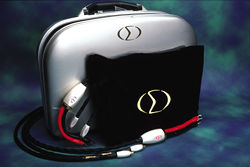
And "luxurious" doesn't even begin to describe their packaging. If you buy the full system kit—a pair of 8' speaker cables packaged with 6' and 3' interconnect pairs—it all comes in a brushed Halliburton-style aluminum briefcase, the cables themselves snuggled in soft, velvet bags.

Monster Sigma Retro Gold interconnect
The Sigma Retro Gold interconnects use three different gauges of six-nines copper conductors. They're drawn and annealed to Monster's spec, then wound with the company's patented Microwire thread. This serves three purposes: it creates a mostly air dielectric, correctly spaces the conductors, and prevents any noise generated by their rubbing together. The wrapped conductors are then wound in a variation of a Litz construction, with the smaller conductors more concentrated near the surface of the bundle and the larger ones near the center. The winding architecture is based on the principle of having each conductor spend an equal amount of time at the bundle's surface as at its center, but is modified based on the different conductors' ratios of "skin" to "core," to try to balance out their propagation speed across the frequency spectrum.

The bundles—two in the case of the interconnect—are each encapsulated in an extruded PEX-2 insulator dielectric. Next, they're wound using an architecture Monster calls Super Multi-Twist, designed to reject audio bandwidth distortion, and the twisted pair is encapsulated in another extruded PEX2 tube. The outer tube is surrounded by two shields, one foil and one braided, which are tied to one end of the cable and covered by the soft fabric I mentioned earlier.

My first impression of the Sigma Retros, after a couple of evenings of serious listening, was very positive. They struck me as very good-sounding cables that seemed to be doing everything pretty well, and that were free of any overt colorations. As I listened over the next few evenings, I made a quick run through the audio checklist: bottom-end definition and punch, high-frequency air and extension, nicely detailed midrange with rich tonal colors, expansive soundstage, solid three-dimensional images. The Sigmas earned an A+ in every subject. Everything that I knew my system could do was being done, with nothing added or removed.

Over the next several evenings, I listened more carefully, homing in on specific aspects of the Monsters' performance, and occasionally comparing them to one or more of my reference interconnects: Audience's Au24, Nirvana's SX-Ltd., and Nordost's Valhalla. All three are superb, but each has a slightly different personality. The Nirvana is smooth and natural-sounding, perhaps a touch warm, with blacker-than-black silences and the best ability to re-create a coherent acoustic picture I've heard. The Valhalla is ever so slightly cool, and the fastest, airiest, most precise cable I've ever had in my system. The Au24 sits midway between the other two, with a dead-neutral tonal balance and a pretty even mix of their strengths and weaknesses.

In terms of tonal balance, the Monsters matched the Au24's neutrality. There was no extra warmth—cellos sounded like cellos and violas like violas, and female vocals were intimate, but with the correct mix of delicacy and body, and none of the extra huskiness that some cables and components can add. Similarly, the Monsters weren't overly cool. There was no emphasis of a guitar's string sound over its body resonance, for example, and no extra steel in flutes, violins, and piccolos.

The Monsters were actually a bit better at the frequency extremes than the Au24s, and had slightly greater extension. They had more impact at the bottom end, but this was due to their improved precision and better pitch definition, not to an increased level. I really noticed the Monsters' great bottom end during Sam Jones' bass solos on "On Green Dolphin Street" and "I Ain't Got Nobody," from the Red Garland Trio's Bright and Breezy (LP, Riverside/Jazzland SMJ-6099, Japanese import). Things like the finger movements against the strings, the pitch changing as Jones bent the strings, or the snapping, changing vibration of the strings themselves, were more vivid and electric with the Monsters.

The Sigmas were similarly stellar in their speed, clarity, air, and extension at the top end. Charlie Persip's cymbals on Bright and Breezy had a marvelous ring, with just the right mix of bell-like tone and metallic edge, surrounded by wonderful cascading waves of outward-radiating shimmer. The way a piccolo could cut through the air above an orchestra was also spot on with the Monsters, perfectly balancing the instrument's cutting edge and sweet, hollow tone.

Edge definition and detail were superb. The Monsters' sonic picture was a little sharper and more obvious, in fact, than with either the Au24s or the Nirvanas—more akin to the Nordost Valhalla in this respect. The most obvious example of this I heard were the maracas on Jimmy Buffett's "Migration," from A-1-A (ABC DSD-50183). Through the Monsters, they had exactly the right hollow sound, and their movements in space were beautifully transcribed. I'd swear I could count the individual beans rattling and swirling around inside. In addition to the detail, the Monsters also had a sort of "crisp mountain air" clarity—the spaces between images seemed cleaner and more open, which made the images stand out even more sharply.

The Monsters were also excellent in their reproduction of dynamic transients, and in their re-creation of images and soundstages. In these areas they were somewhere between the smoother, more coherent Au24 and Nirvana and the explosive, wide-open Valhalla. They had a slightly more forward soundstage and more projection than the Nirvanas or Au24, and things like rim shots and sharp guitar chops were just a bit sharper and faster—though not up to the standard set by the Valhallas.

On the other hand, while the Monsters' images were dimensional and their soundstages large—particularly in width and height—they didn't have quite the image dimensionality or soundstage depth of the Nirvanas or Au24s. Both of those latter cables replaced my listening room with a stunningly natural, completely coherent reproduction of the original acoustic space, with a sort of walk-into-it depth and seamless ambience. The Monster interconnects were very good, but not quite as good. On the flip side, however, the Monsters—or the Valhallas—made things like miking patterns more obvious, and better distinguished between the specific environments around individual instruments in multimiked studio recordings.

Summing Up: The Monster Sigma Retro Gold interconnects were superb performers. They were on a par, overall, with my three reference interconnects—Nirvana SX-Ltd., Nordost Valhalla, Audience Au24—but with a slightly different set of strengths and weaknesses. The Monsters should sound great in any system, but whether or not they prove to be the single, absolute best match will depend on other factors, including associated equipment, source material, and listener preferences. The Sigma Retros and my reference cables all work beautifully in my current setup, and I could happily live with any of them. For now, I'm sticking with the Monsters.

Monster Sigma Retro Gold speaker cable
Monster's Sigma Retro Gold speaker cable is similar in construction to its interconnect sibling, but a bit simpler. In the speaker cable, each conductor bundle uses two different gauges of six-nines copper conductors, again wrapped with microfiber, then woven around a solid, nonconducting core. The bundles, again two, are encased in extruded PEX-2 insulators and laid up using Monster's Super Multi-Twist architecture. In the case of the speaker cable, there is no outer PEX2 tube and no shielding—the twisted pair is wrapped directly in the fabric. Terminations are 24k platinum-gold-plated spades of three different sizes.

As with the interconnects, my first impressions of the Sigma Retro Gold speaker cables were all quite positive. I let the cables break in by running my system 'round the clock for several days, and though I didn't do any serious listening during this time, the music was always in the background, and I did sit down for a few minutes here and there, just to relax and listen. The sound was great: vivid and engaging, but with nothing overt jumping out and demanding attention—no overt anomalies, in other words. I always hated to get up and leave the music.

As I listened more carefully, homing in on the details of the Monsters' performance, I continued to be impressed. Their overall performance and character were very similar to the Sigma Retro interconnects, and very similar to my reference Audience Au24 cables (Nordost Valhalla was my other reference).

Like the Au24s, the Monsters were tonally very neutral, though there were subtle differences in their personalities. While I wouldn't say either was right or wrong, or that the Monsters sounded "cool" or "lean," they weren't quite as warm- or rich-sounding through the midrange as the Au24s. Red Garland's Bright and Breezy was a great example. The Monsters did a fantastic job of capturing the initial attack of the piano hammers hitting the strings, but the Au24s filled in slightly better the notes' bloom and resonance following the initial transients.

On drums, too, the Monsters' attack was sharp and realistic, but the round skin tone behind it, particularly in the case of lower toms, wasn't quite as rich and tonally dense as with the Audiences. Ditto for Thad Jones' cornet on the wonderful The Thad Jones/Mel Lewis Quartet (Artisthouse AH 9403). With the Monsters, Jones' cornet had a bit more brassy blare; with the Au24s, a little more golden bloom. On the other hand, the differences between the Monsters and Nordost's Valhalla were in the opposite direction, and a bit larger. The Monsters had a significantly richer, more tonally dense sound than the Valhallas, but not their speed and precision.

The Monsters were excellent at the frequency extremes, and kind of a hybrid of my two reference cables. Their accuracy and excellent reproduction of dynamic transients extended to the very bottom, sounding a lot like the Nordosts in this regard. They didn't, however, have quite as much bottom-end warmth or power as the Au24s. For example, the Au24s made Sam Jones' bass sound a bit bigger and warmer; through the Monsters, the instrument sounded slightly cleaner and more precise.

On top, the Sigma Retros were again clean and precise, but not quite as extended as either the Audience or Nordost wires. With the Monsters, Charlie Persip's cymbals on Bright and Breezy had a sharper, more powerful initial crash, but the shimmering waves moving outward were a bit attenuated. Or, for another example, listen to the maracas on "Migration." With the Monsters, the sharp, hollow attacks when the instrument is shaken were very precise, and snapped with a very realistic impact. When the instrument was swirled around, however, some of the low-level, higher-frequency subtleties weren't as evident—the ssshhhh was a bit deeper in pitch and just slightly dulled.

The Sigma Retro speaker cables revealed huge soundstages, although, as with the interconnects, these stages were a bit more wide and tall than deep. Individual images were nicely detailed and tangible, but not quite as dimensional as with my reference cables. Unlike the Sigma Retro interconnects, which had a consistent, slightly forward perspective, the speaker cables were more neutral, neither noticeably forward nor at all recessed.

The Sigma speaker cables' resolution of detail and edge definition were superb, and there was the same beguiling, crystal clarity in the spaces between images that I noted with the Sigma interconnects. Also like the interconnects, their ability to precisely describe miking patterns, or the fragmented spaces blended together in a studio recording, was incredible. Buffett's A-1-A really showed this off. In the closing moments of most of the songs, as they fade out, there are very soft percussion instruments. Even at the limit of audibility, the sizes and characteristics of the spaces around these instruments remained discernible.

Summing Up: As good as Monster's Sigma Retro Gold speaker cables were, I wasn't quite as taken with them as I was with the interconnects. It's odd, because both wires had very similar characteristics, and I'd be hard-pressed to say in which wire these characteristics were more obvious. But while in my current setup I slightly preferred the Monster Cable interconnects to my other reference wires, I preferred—again, only slightly—the Au24 speaker cables.

On the other hand, it's possible that the Sigma Retro Gold speaker cables are a bit more narrowly focused than the interconnects, and Monster's targeting of the SET market in their development of the Sigma Retro line has resulted in a speaker cable that's not ideally suited to my 600W VTL Ichiban monoblocks and power-hungry Thiel CS6 speakers. But even with this potential mismatch, the bottom line is that these are still great speaker cables. Depending on your associated equipment and listening preferences, they might be absolutely perfect.

Where does that leave us?
It's been a while since I thought about Monster Cable in the context of super-high-end cables. Sure, their product name, like Scotch tape or Xerox, has become synonymous with an entire industry. To the rest of the world, Monster Cable is high-performance cable. But somewhere along the line, rightly or wrongly, they lost their high-end credibility—at least with me. It became easy to dismiss them as "no longer a high-end company." And who could blame them? The world and its riches lie in Game Boy and car audio cables, not in our tiny little audiophile utopia.

But somewhere deep inside Monster Inc., Sigma Retro Gold was conceived and now exists as a kind of outlaw. It's ironic, because the technological and financial power that make possible the development of special materials and constructions such as the ones in the Sigma Retro Golds also put very real constraints on the bottom line. When Demian Martin discovered the superior performance of his platinum-gold-plated spade lugs, he toyed briefly with similarly plated conductors, "but I knew that [head monster] Noel Lee would never go for it because of the expense. I'm just grateful that we were able to build Sigma Retro in a company like Monster. I'm not sure that Noel is even really aware of this product, which is probably good for me."

It's certainly good for us. Outlaw product or not, Demian Martin and Monster Cable have built a line of superior cables in their Sigma Retro series, cables that are fully competitive with the very best I've heard. In some ways—how they balance continuity and edge definition, for example, or the amazing clarity between their images—they might well be the best I've heard. In other areas, or in other systems, I might prefer another of my reference cables by a bit. I can't say whether or not these cables will be the best match for a particular system and listener. I can definitively say, however, that anyone shopping for high-end cables should give them a listen. Highly recommended!

Related Links...

Read More...

Stereovox SEI-600II & LSP-600 interconnect & speaker cable

Stereovox SEI-600II & LSP-600 interconnect & speaker cable 
HI-FI, Sterio, Home Theater, Audiophile, Amplifier, Speaker

What I find fascinating is that, in an industry as mature as audio cables, a new company can appear out of the blue and upset everything." He was gently poking fun at my admission that I found cable design fascinating, in particular the practice of combining different conductor materials.

JA's comment was understandable. After all, in 1995 we already had round, flat, and tubular conductors made of silver, gold, and copper, as well as various alloys and combinations of different core and plating materials. There were cables shielded by various fabrics and polymers, Teflon, air, water, and even light. Some were shielded, some weren't; some had exotic termination circuits; a few even came with power supplies that applied a bias voltage to their shields. It seemed as if most of the technical avenues had already been explored and were being represented by manufacturers then active. And now here we are, a decade later, and new high-end cable makers continue to emerge.

Where have I heard that name before?
Stereovox isn't exactly new. It was established as a cable company in 1999 by Chris Sommovigo and longtime partner Antonio de Almeida Santos, and Sommovigo's presence in the industry goes back much further still. He started Illuminati in 1992 with what was, arguably, the first true 75-ohm digital S/PDIF cable, and thus the first design to address the problem of reflections due to mismatched impedances. A later Illuminati model, the Orchid, is widely and fondly remembered as the first really killer digital cable.

Sommovigo then moved to Utah, where he worked with Ray Kimber of Kimber Kable: Kimber distributed Illuminati products, and the two worked together on a product-development effort. That project didn't work out, but during this time Sommovigo and Santos launched a recording company, Stereovox, and began with a recording of the Moscow Symphony made in the winter of 1996. The arrangement with Kimber ended, the existing Illuminati designs became Kimber Kable products, and Sommovigo began designing cables on his own again—to be marketed under the Stereovox banner.

The first two Stereovox cables, the SEI-600 interconnect and LSP-600 speaker cable, were introduced, to rave reviews, in 1999. They sounded great and had unique, machined-from-rod aluminum connectors made by a company called Xhadow. Scratch the surface a bit and you find out that Sommovigo is part of Xhadow as well—his partner there is Stuart Marcus, of Vampire Wire and Sound Connections fame. Unfortunately, the Stereovox cables' introduction coincided perfectly with the dot-com crash—"bad timing for a cost-no-object luxury product," Sommovigo wryly noted. Never deterred for long, he went about redesigning versions of the cables that were less expensive to produce, and incorporated a few new ideas in the process.

It's what's inside that counts
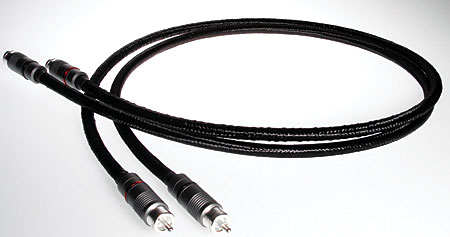
All current Stereovox analog cables share a common design: a twisted-pair arrangement of two identical coaxial conductors, and some other bits I'll shortly describe. At the center of each coaxial conductor is a fine conductor of solid-core silver. Air-articulated, or bubbled, Teflon tape is wrapped helically around this, after which the tape's surface is lightly sintered to produce a consistent interface with the next layer, the shield. The shield is not a standard braided or foil type but an extremely fine, multi-conductor wire of silver-plated copper, which also is helically wrapped around the cable. Teflon is then sintered onto the outside of the shield. Two of these assemblies are twisted together, the bundle encased in a PVC jacket and an outer sheath of Nomex.

At each end of the cable the two grounds are joined, as are the two center conductors, and the appropriate Xhadow connector is attached via a clamp-and-solder process called Intimately Stressed Contact. There are actually two more Teflon-shielded silver-coated copper conductors alongside the twisted pair—the "other bits" mentioned above. These are there but are not used in the single-ended interconnects and speaker cables, but form the third conductor in the balanced interconnect.

Everything about the Stereovox cables oozes luxury, from the spiffy aluminum briefcases they're packaged in to the way they solidly connect with just a light push. I'm no fan of the polished, chrome-plated flash I see in some audio jewelry, and I'm intolerant of the excessively thick and rigid stupidity that's sometimes equated with high-performance cables. The Stereovox wires, on the other hand, are right on the mark. They're small, flexible, easy to route, and, as I noted above, make getting a solid connection nearly idiot-proof, even in hidden, impossible-to-reach places.

Lovely to behold and delightful to install, but...
The performance of high-end gear has improved dramatically since JA made his comment back in 1995. The latest generation of electronics—such as the Halcro dm58 and VTL S-400 power amplifiers—are incredible. They have eradicated enough of the colorations inherent to solid-state and tube designs, respectively, that they sound more like each other than each does its own predecessor. The best modern turntables sound much more neutral, and much more alike, than they did only a few years ago. Phono cartridges, CD transports, and even integrated CD players are all moving steadily toward a common neutrality—or toward a common, apparently fundamental limit in how nearly absolute neutrality can be approached.

A similar maturation process has occurred in the cable world, with each generation of designs sounding less colored and more alike than the previous one. With today's best cables, it's no longer possible to talk about the consistent character of silver conductors, for example, or the different sounds of coaxial, flat-conductor, or Litz-wire geometries. Today's best cables approach neutrality closely enough to challenge the terms colorations and distortions, and can instead be discussed in terms of providing slightly different perspectives on neutrality. Without question, the Stereovox cables fall solidly into this group, and deserve to be compared with the very best. They may or may not be a listener's top choice, depending on his or her gear, software, room, and preferences, but they'll be contenders—provided the listener wants to actually hear what the rest of the system is doing.

My two longtime reference speaker cables and interconnects, Nordost's Valhallas and Nirvana's SX-Ltds, are two of today's very best, and sit at opposite ends of the spectrum in their approach to neutrality. The Valhallas are all about speed, clarity, and definition, and are slightly cool in their reproduction of instrumental timbres. The Nirvanas' strengths are their coherence and their rich, natural portrayal of tonal colors and textures—but they lack the Valhallas' transient speed and edge definition. Two other designs I've reviewed recently, the Audience Au24 and Silversmith's Silver, fall in between: tonally more neutral, but not quite matching the Nordosts' or Nirvanas' strengths.

It's against this backdrop that the question arises: Are Chris Sommovigo's latest Stereovox creations more examples of the state of the cable art, or are they harbingers of the next plateau in cable design? In terms of tonal balance, the Stereovox wires resembled the Valhallas quite closely. Male vocals had slightly less body and solidity than through the Nirvanas, or than they do live. The timbres of closely miked guitars and cellos was leaned out slightly as well, though not to as great an extent as with the Valhallas. Both the Stereovoxes and the Valhallas can sound neutral with the right surroundings, but the surroundings will likely be right more often with the Stereovox cables.

The Stereovox wires distinguished themselves more dramatically in their handling of other aspects of a recording: dynamic range, temporal precision, edge definition, and how well they balanced all of these with tonal complexity, image density, and coherence. To compress my six months of listening to all types of music into an easily digested example, pull out an LP of Dire Straits' Making Movies (Warner Bros. BSK 3480) and cue up side 1. Everyone over the age of 40 has a copy, and it's a nicely recorded album with excellent dynamics, a wealth of detail, and pretty well-balanced portrayals of voices and acoustic instruments.

With my system and in my room, which are pretty decent and, if anything, slightly warm-sounding, the Stereovox cables were the best I've yet heard at balancing this mix of competing attributes. The sharp drum rolls in "Romeo and Juliet" were startlingly explosive, yet had a solid, realistic body and skin tone. Mark Knopfler's arpeggio resonator guitar lines were right on the money as well, each note beginning with a sharp snap and developing into a hollow, metallic tone that combined a shallow, metallic plink with a softer, deeper ring. In comparison, the Valhallas gave the drums and guitar a bit too much contrast, with overemphasized transients and not quite enough body. The Nirvana SX-Ltds, on the other hand, produced wonderfully dense, complex, and dimensional images, but with neither the impact nor the clarity they had with the Stereovoxes or Valhallas.

Other examples: the image of Knopfler's voice was precise, but a bit anorexic with the Valhallas; he was back up to fighting weight with the Nirvanas, though slightly soft in his articulation. With the Stereovox wires, the portrayal came close—not quite there, but awfully close—to combining the best attributes of the Valhallas and the Nirvanas. The nearly spoken passages two-thirds of the way through "Romeo and Juliet" were particularly telling. Knopfler's image and the surrounding echo were crystal clear with the Valhallas, the apparent boundaries of the space around him precisely located—but the three were so sharply bounded that they were almost disconnected. The opposite occurred with the Nirvana SX-Ltds: there was a realistic, natural coherence, but neither Knopfler nor the walls had quite the certainty or specificity they should. Here again, Sommovigo's Stereovox cables approximated a best-of-both-worlds balance.

The way the Stereovox wires re-created space also seemed a bit more "right" than I've heard with other cables. Prior to spending time with them, I found it easy to accept the perspective of whichever cable, Nordost or Nirvana, was in my system at the time. The Valhallas gave me smaller, more focused images and a more dramatic sense of the space between them. The SX-Ltds produced a larger, more coherent soundstage, but with a slightly softer focus. Despite their differences, both seemed reasonable, and more right than wrong. The Stereovoxes' middle ground and combination of strengths raised the bar, however, and made me more aware of the compromises the other two were making.

Analogue Productions' incredible 45rpm set of Creedence Clearwater Revival's singles (Analogue Productions AAP CCR7) arrived about halfway through my listening sessions and thereafter monopolized my turntable. Maybe my sensitivities were heightened through immersion and repetition, or maybe I was just OD-ing on CCR, but I found myself getting unreasonably picky about everything. I kept cleaning my stylus. I revisited my cartridge's alignment. I meticulously scrubbed the records and double-checked the positioning of my Wilson Audio Sophia 2 loudspeakers. I experimented and made sure that the door and windows were opened just so, and made my Catahoula Zippy curl up in exactly the right spot. Everything mattered, and all of it seemed to bug me. With the Valhallas, there was a glare in John Fogerty's voice that I found unlistenable. I could listen through the Nirvanas for hours on end, but I just wasn't getting into the music. With the Stereovox cables, it all fell into place. For two weeks straight, I stopped tweaking and fidgeting and just enjoyed the music.

Summing up
I was really impressed with the Stereovox cables, and strongly recommend that anyone shopping for cables—or just looking to upgrade and learn more about their system—arrange an audition. I don't know what represents good value in high-end cables any more, or even what that phrase might mean, but $1000 for interconnects and $2500 for speaker cables is probably credible, if not necessarily sane.

The Stereovox cables aren't perfect or perfectly transparent. They have less, though still some, of the cool tonal balance and transient edge that limit the Nordost Valhallas—but they have all of the Valhallas' speed and clarity. The Stereovoxes are more dynamic and temporally precise than Nirvana's SX-Ltd, yet retain much of their coherence and tonal richness. Time will tell if the SEI-600II and LSP-600 are the first of a new generation of cables that will establish a new standard of performance, but they are, at the very least, among the select group of cables that comprise "the best I've heard." Even in 2006, an industry as mature as high-end cables can be shaken up. Fascinating, isn't it?

Related Links...

Read More...

JPS Labs Aluminata interconnect, speaker cable, AC cord

JPS Labs Aluminata interconnect, speaker cable, AC cord JPS Labs Aluminata interconnect, speaker cable, AC cord JPS Labs Aluminata interconnect, speaker cable, AC cord JPS Labs Aluminata interconnect, speaker cable, AC cord JPS Labs Aluminata interconnect, speaker cable, AC cord JPS Labs Aluminata interconnect, speaker cable, AC cord JPS Labs Aluminata interconnect, speaker cable, AC cord JPS Labs Aluminata interconnect, speaker cable, AC cord JPS Labs Aluminata interconnect, speaker cable, AC cord JPS Labs Aluminata interconnect, speaker cable, AC cord HI-FI, Sterio, Home Theater, Audiophile, Amplifier, Speaker

Taken together, these unusual interconnect, loudspeaker, and AC cables brought a new measure of spaciousness, scale, smoothness, heretofore unimagined detail, and overall musical ease and naturalness to my music system. And they did it while sounding neither dull nor bright—just right.

I start with that observation not in an effort to be cute, but as a good-natured warning to ill-natured skeptics: Unless you're open to the idea that such a thing is possible, the 2300 words that follow will be little more than nonsense, howsoever differently I intend them.

There's more: From the moment JPS Labs offered to loan me these review samples, right up through the bulk of my listening and note-taking, I didn't know how much they cost. Of course I assumed they weren't cheap, given that designer Joe Skubinski described the Aluminatas, in genuinely excited tones, as his best ever. But it never dawned on me that a 1m interconnect pair, for example, would retail for $2999. And when I did look at the Aluminata portion of JPS Labs' price list, I shifted uncomfortably in my seat.

Description
Just as Audio Note has its silver wire and Cardas its golden ratio, JPS has a calling card of its own: a proprietary conductor material called Alumiloy. Nominal appearances aside, pure aluminum is not the main ingredient of Alumiloy—although it plays a role, and may well give the finished product some of its signature strengths. Aluminum is low in density, nonmagnetic, and highly malleable. It also conducts electricity well, being surpassed in that regard only by the usual suspects: copper, gold, and silver.

But the greatest distinction of JPS's Aluminata line lies beyond its choice of conductors, in a realm where aluminum does play a decisive role. As Joe Skubinski sees it, the main challenge faced by a connecting cable of low reactance and resistance, where conductor mass and configuration are already appropriate to the current being passed, is that of outside interference. So he developed a cable shield to end all cable shields: Skubinski surrounded his insulated conductor cores with a thick blanket of granulated aluminum, densely packed and held in place with a polymer jacket. The result, called a Particle Aluminum Shield or PAS, is more flexible than a solid tube, yet many times thicker than a braided shield, with the potential for vastly better RFI and EMI shielding than any other practical solution—and a few that aren't.

That wasn't quite enough: Surrounding an electrical conductor with a metal tube and separating the two with a dielectric creates a crude sort of capacitor, with high-frequency AC finding a fairly easy route from the former to the latter. For the tube to function as a shield within an electrical system, it must be grounded at one end: common practice, in any event. Unfortunately, as Skubinski says, RFI sees that connection to ground as an impedance: Noise picked up by the antenna-like shield is dispersed through the system, and little of that energy actually makes its way to the electrical ground.

Skubinski wanted to make a cable that could itself absorb and dispense with any RFI and EMI energy, so he came up with an interesting variation on grounding the shield: He added a length of absorptive material—the precise substance remains undisclosed—between that thick layer of aluminum particles and the ground reference point of each Aluminata cable, which follows a conductive path to the ground. For the Aluminata interconnects, the ground point is at the source end; for the speaker cables, it's at the amplifier end; and for the AC cords, the ground path is at the same end as the wall receptacle.

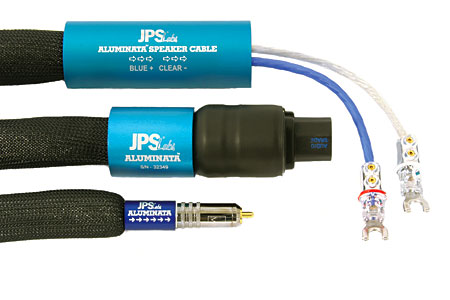
Apart from their common approach to shielding, the three types of Aluminata cable I tried are built with different conductor sizes and configurations—not to mention their obviously different terminations. Aluminata interconnect begins life as a quartet of 15-gauge solid-core Alumiloy conductors, insulated with the flexible polyimide Kapton and terminated with WBT locking phono plugs. Aluminata AC has three 8-gauge alloy conductors, also insulated with Kapton, and uses a Wattgate plug and IEC connector, both with gold-plated contacts. JPS's largest Alumiloy conductors are reserved for the Aluminata speaker cable: a twisted pair of 5-gauge solid-core, insulated by hand—using cotton gloves, so skin oils won't be left behind on the otherwise clean alloy surfaces. The 6" leads at the ends of the Aluminata speaker cables are 8-gauge stranded alloy wires insulated with Teflon. Those leads are crimped and soldered to the 5-gauge Alumiloy conductors inside the cable structure itself, and are terminated with the buyer's choice of WBT spade lugs or locking banana plugs. Crimped connections on all JPS Aluminata cables are made and remade several times before the cable is finished—a prudent move, given the tendency of certain alloys to expand and contract with greater ease than others. Only lead-free solders are used.

Installation and setup
I tried the Aluminata cables, both individually and as a more or less complete connection rig (minus the tonearm lead and various remaining AC cords), in my main system: Linn LP12 record player and Sony SCD-777 SACD player, Artemis and Lamm preamplifiers, Quad and Lamm amplifiers, and Quad ESL loudspeakers.

All of the Aluminata cables were at least somewhat unwieldy: Bending them to a radius much smaller than 6" took more coaxing than usual, although they were far from the stiffest I've used. The more severe challenge was posed by the cables' substantial weight: The granulated aluminum shielding alone adds over a pound to every meter of stereo interconnect, and even more to the speaker cables and AC cords. Taken as a whole, the 1m Aluminata interconnect pair weighed approximately 2.5 lbs, and a single Aluminata AC weighed over 5 lbs. By comparison, a Quad monoblock amplifier weighs about 16 lbs.

Weight was more of an issue with the speaker cables than the other Aluminata models: Their stranded termination leads were, of course, significantly more flexible than the rest of the cable; in my system, with the Quad ESLs raised somewhat inelegantly off the floor, the combination of heavy cables and floppy leads made hooking up a clumsier procedure than usual. Those WBT locking bananas weren't just a luxury, they were a necessity—without them, the Aluminata speaker cables disconnected themselves.

During their stay here, the JPS Aluminatas all worked without a hitch. I should also mention that even the most careful listening failed to detect any change in their performance during that time.

Listening
The first Aluminata cable I tried was the 6m interconnect pair, which seemed to lock in with my Lamm electronics from the start. Going from the very good Nordost Heimdall interconnect pair (reviewed in the January 2007 Stereophile) to the JPS Aluminata made for one of the most remarkable differences I can remember hearing between two nondefective audio cables. With the Aluminata in place, my system's performance was spacious and smooth—extremely smooth—and noticeably, obviously noiseless. Silences and spaces between notes and sonic "images" weren't even black: They were just dead-empty. Tunefulness, rhythm, and musical flow were all superb. Electric bass notes, as on the Jayhawks' "I'd Run Away," from Tomorrow the Green Grass (LP, American 43006-1), were dead-on in terms of pitch, with extremely well-defined attack and decay components. The long Aluminata interconnects, used from preamp to amp, also made my system sound larger overall, with a more convincing gradation of scale between the extremes.

Over the next few days I added the remaining Aluminata cables, one at a time: the 1m interconnect pair between phono preamp and preamp, the 2m pair between CD player and preamp, the speaker cables, and the AC cords with various components. The strengths I described above only expanded—especially the noiselessness, and my system's consequent gains in detail retrieval.

Remarkably, the last application I selected for the two Aluminata AC cords—powering my Quad ESL loudspeakers—made the largest qualitative leap of all. And to think that, as recently as 2003, I was an AC-cord skeptic!

With all of the JPS Aluminata products in place, my system had the same essential qualities as before: realistic texture and presence, an emphasis on musical flow and momentum, a bit of softness up top, not the world's highest ceiling in terms of drama and scale but convincing enough within those constraints. Yet my system's flaws were now less glaring, and almost all of its better qualities were enhanced. It was as if the whole system had been given an easier task.

I mentioned detail retrieval at the start, and on that count I scarcely know where to begin. There were a number of specific things I noticed for the first time with the Aluminatas in place, such as the neat chord changes played on the banjo in Randy Newman's cleverly arranged "Lonely at the Top," on Sail Away (LP, Reprise MS 2064), or the simple pleasure of hearing Newman tapping his foot during "God's Song," varying his intensity as the lyric progressed. And while I'd heard it plenty of times before, I now had a clearer glimpse of George declaring "I fucked it up!" just before the three-minute mark in "Hey Jude"—that and the fact that it's John, not Paul, who begins singing the lead at 6:48, just before the song fades out.

On the Band's "Strawberry Wine," from Stage Fright (LP, Capitol SW-425), the improvement wrought by the JPS cable combination was downright amazing. Richard Manuel's beautifully loose, crazy drumming gained impact and tone—the latter especially in the kick drum and floor tom, which now resonated more richly and believably than before. Robbie Robertson's guitar playing seemed less calculated, more spontaneous than usual. And, again, a wealth of subtle details was uncovered, such as Levon Helm's enthusiastic guitar strumming, and the backing vocals that were left unused for the LP mix—wisely, I think—but that nonetheless bled into an adjacent track.

Classical records enjoyed similar gains. That most mysterious and spiritual-sounding of all recordings of Wagner's Parsifal, the one made at Bayreuth in 1962 with Hans Knappertsbusch and erstwhile Lohengrin Jess Thomas, sounded even more mysterious and spiritual. Audience noise was easier to hear, of course—yet so were the players' subtlest intentions, with triplets and dotted notes becoming clearer in their rhythmic nuances. The clarity of intent that characterizes most of Knappertsbusch's recordings—his ability to make a large orchestra play like a smaller ensemble, while retaining its sheer scale and power—was brought to the fore.

The most stunning difference of all was in the hall sound itself: The full suite of Aluminata cables made that aspect of this very good recording even more obvious. It was exciting to hear how the ambient sounds changed as the soloists moved about on stage, and even more so with the full choir of Grail knights, as during the finale. Dramatic inflections in Knappertsbusch's subtle (and temporally drawn out) performance were also magnified with all of the Aluminatas. Similar ambient gains were obvious when I listened to the recording of Richard Strauss's Intermezzo that Joseph Keilberth and the Bavarian State Orchestra made in the 1960s at Munich's historic National Theater (Telefunken SLT 43085). The JPS cables gave the already generous hall sound on that LP a greater sense of physical depth, while allowing the instruments themselves to sound more substantial, less wispy and fussy.

As my time with the Aluminatas played out, I went back to the beginning and again experimented with different cable applications on their own, one at a time. Even the least expensive of the Aluminata samples—the 1m interconnect pair—made a clear and unambiguous change for the better in the sound of my system. Yet still, the Aluminata AC cords, used on my Quads, made the most significant improvements of all.

Conclusions
Raving about any cable, let alone ones so costly, makes me nervous. But, as a spin through my reviews in Stereophile's Web archives will demonstrate, I've never hesitated to suggest when a sonic difference was so slight that I might have imagined it.

That reticence isn't appropriate here: The differences made by the JPS Aluminata products were by far the most drastic changes I've ever heard when going from one interconnect, speaker cable, or AC cord to another. Put a little more bluntly, I've never heard wire do this before.

But as I write this, in mid-January, my property taxes are due, I have two usurious credit-card accounts loaded down with Christmas expenses (and amplifiers and resistors and tubes), everyone in the house needs new eyeglasses, my family would like very much to return to Martha's Vineyard this summer, at least for a weekend...and so would I. And here I am dancing around the fact that someone has sent me $40,193 worth of wire—and, gee whiz, whaddaya know, I want to tell the world how great it is.

But it is great, and there's not much I can do to change that.

Are the JPS Aluminata cables worth the money? Yes and no. Yes in the sense that one little company has worked like hell to design some evidently noiseless cables, then built the things up, virtually from scratch. Yes in the sense that, if listening to recorded music is the most important thing in your life and you have barrelsful of money, you should do everything in your power to maximize your playback system—including this. No in the sense that it's unreasonable to spend $40,193 on a set of audio cables—an amount of money that could otherwise buy a luxury automobile, or perhaps an evening of abdominal surgery.

It's your call. At the end of the day, all I can say is that the Aluminatas are, without a doubt and by a significant margin, the best audio cables I've used.

Related Links...

Read More...