Showing posts with label CD receiver. Show all posts

Sunday, November 9, 2008

Rega Apollo Top Loading CD Player

Why Apollo CD Player?


DSC_6964.jpg


Rega is famous with its turntable and for CD Player, Apollo is one of its brilliant invention.


The world has moved on since then, for better and for worse: better in the sense that digital sound has continued to improve, worse in the sense that the major corporations with the technology for making integrated digital control systems-the basic servo and data-control chipsets-have shifted their focus toward DVD and away from the humble music-only compact disc. That state of affairs has prompted Gandy and company to tap a different technology source, and to launch an entirely new player: the msrp RM4,599 Rega Apollo.


Rega Apollo incorporates more than 20MB of memory, along with true 32-bit processing capabilities. That's several times the power of early digital control systems. The CD comes with a great operating mechanism and a better power supply. It supports MP3 playback as well thought audiophile seldom opt for mp3 compressed audio. But you never know when you need this feature so it's always better to have it :)


DSC_6967.jpg

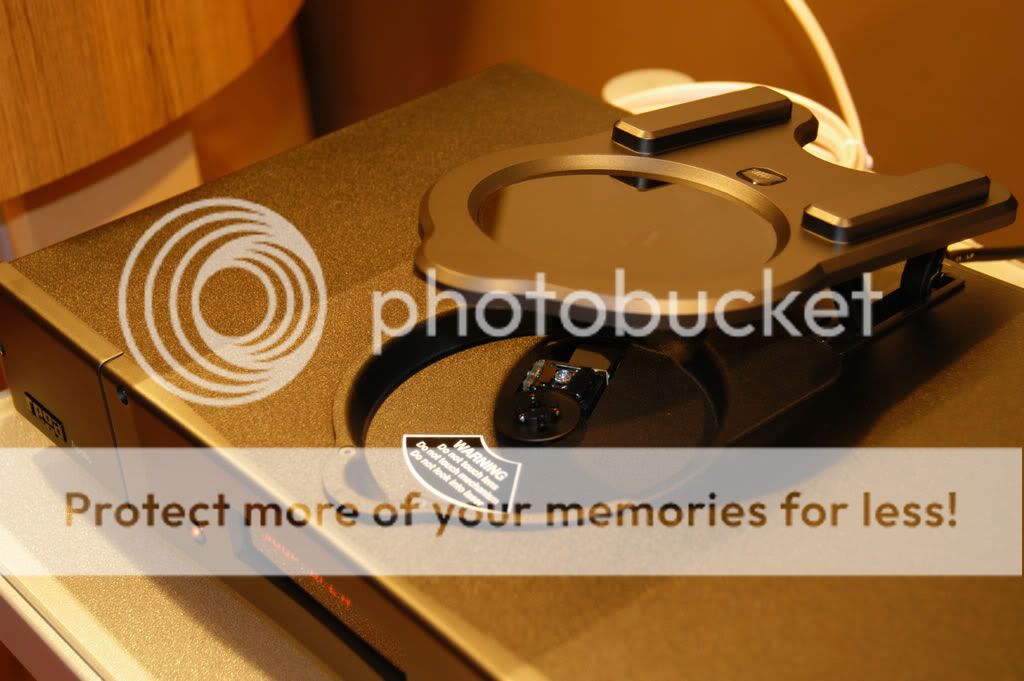
The Apollo is built into the same casework as the Rega Planet, with one key difference: The new player's transport holds the disc with a three-point ball chuck instead of a magnetic puck. That means the motor has less mass to spin, so the disc can accelerate and decelerate with greater ease. It also means that Rega's already elegant transport lid is now a single, undisturbed expanse of smoked Plexiglas-which looks very nice indeed.


The Apollo's transport, manufactured by Sanyo, is compliantly suspended from the upper portion of Rega's standard chassis of cast aluminum alloy. The D/A converter is Wolfson's top-of-the-line WM8740, a dual-differential chip that operates in sigma-delta mode and supports word lengths of up to 24 bits. The output section, which is said to apply class-A amplification to a digital source component in an entirely new way, is Rega's own design.


Apart from all that, the Apollo is a straightforward thing, with a front-mounted board for the logic bits and a single main circuit board for all the rest, fastened to the bottom of the chassis alongside the smallish toroidal mains transformer. RCA and optical digital output jacks are on the rear panel for those who wish to use an outboard DAC, as well as the usual pair of phono jacks for line-level analog output. In addition to the mains switch, the front panel has only the most basic start, stop, and track-advance buttons, while those and a full brace of other user controls appear on the nicely styled remote handset-including a button that can be used to kill the display lights. To jump ahead just a bit: As with the same feature on recent CD players from Naim Audio, that last one really did make an audible difference for the better; all of my comments on sound quality below refer to the Apollo's performance with its display dark.


There is only one little tiny catch on Apollo, that is when a disc is loaded and the transport door closes, the player does not respond further. It will wait for around 5 seconds or so before you can press the PLAY button to start reading the track. The culprit, if you want to call it that, is the new Cambridge-sourced chipset and its attendant surplus of memory: Each time the user loads a new disc, the Apollo reads the whole of the CD's subcode data into memory, analyzes it (footnote 1) and then selects the most appropriate of four levels of error correction. That way, the music is never overcorrected per se, and the integrity of the original datastream is kept intact to the greatest extent possible.


Apollo sounds "Cleaner" as compared to few of the products I have heard. It is more "revealing" and speak out most of the tiny details within the CD track. I can now hear "more" on Apollo than other lower end CD player ( I mean audiophile range CD Player here; not the consumer brand DVD or cd player that you get from the electrical shop that sells fridge and aircond).


Be warned when you feed Apollo with recorded CD media or even odinary CD from the shop. Noises and even some background sound are visible. You can straight away tell if the CD media is original or not or should I say, good recording or bad. At times, I feel Apollo sounds a little too crisp in the high side. For the price tag of msrp RM4,599, is it worth the buy? I strongly recommend it.

Read More...

Friday, May 2, 2008

Nagra CDP CD player

Nagra CDP CD player 
Nagra CDP CD player 
Nagra CDP CD player 
Nagra CDP CD player 
Nagra CDP CD player 
Nagra CDP CD player 
Nagra CDP CD player 
Nagra CDP CD player 
Nagra CDP CD player 
Nagra CDP CD player 
HI-FI, Sterio, Home Theater, Audiophile, Amplifier, Speaker

Audiophiles are frequently accused of being more in love with gizmos than with music. There may be a kernel of truth in that, but a scant few companies actually exploit the giz factor to give you mo'—a lot mo'.

One manufacturer rises above the rest when it comes to invoking sheer gizmoidal lust: Nagra. Since 1951, the Swiss firm has built the gear that professional recordists in the broadcast and film industries have turned to when they couldn't afford to risk using more temperamental components. Nagras were built to work in the field, and to keep working. Hang out with anthropologists and newsmen and you'll hear tales of Nagra Es and Nagra IVs that survived burial in snowdrifts, artillery near-misses, and being run over by tanks.

As if utility weren't enough, Nagra gear tends to be gorgeous as well. In a review in the January 1996 Stereophile, John Atkinson described the Nagra-D open-reel digital recorder as "a small, elegant, immaculately engineered expression of form-follows-function...[that] works as anyone with any recording experience would wish; nothing is unnecessary; every component is designed with an eye to how well it needs to be engineered to fulfill its function; the result is maximum quality, both physical and sonic."

Nagra's CDP CD player ($13,495) doesn't record, but otherwise, JA's description fits it to a T—a shiny, lust-invoking T.

By concentrating on precision, one arrives at technique...
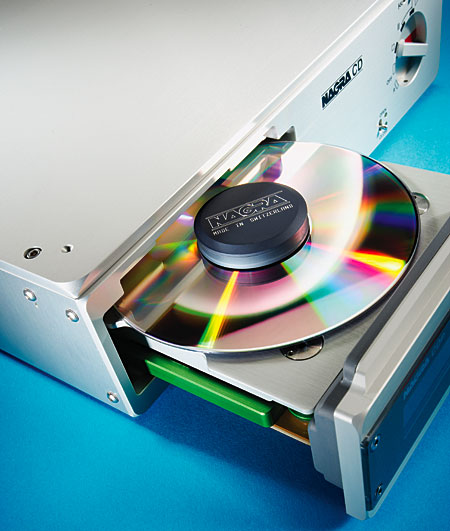
The CDP is a compact (12.2" W by 3" H by 10" D), front-loading player with an outboard power supply that feeds it 12V DC. The brushed-aluminum chassis is almost plain; the main focus is on the front and rear panels. Up front sits what Nagra calls the "mono-block tray," which houses not only the disc drawer but the entire drive mechanism and the backlit LCD display as well. The mechanism slides in and out of the CDP on drawer rails with Swiss horological precision (there, got that out of the way). Also present on the faceplate are three really small switches: display on/off, open/close, and skip. In typical Nagra fashion, there's also a large, mechanical, rotary function switch. This has the usual icons for play, stop, and pause, plus one labeled Off and one cryptically marked "R." That stands for Remote, as I discovered when I finally read the manual in an attempt to discover why the CDP's remote control wasn't working. D'oh!

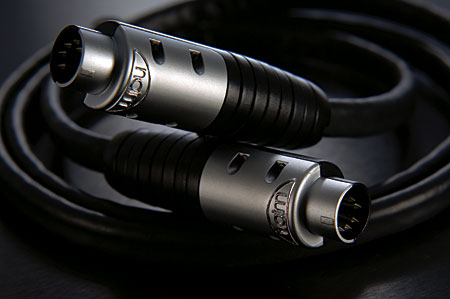
The rear panel accommodates balanced XLR and RCA analog connections, as well as coaxial S/PDIF, AES/EBU, and TosLink digital. (The outputs can be moved to the traditional Nagra side-mounted position.) The ACPS II power supply connects to the CDP via a three-pin Lemo locking connector. There's also a ground connection, linked directly to the CDP's case.

...but by concentrating on technique one does not arrive at precision
Nagra says they pondered long and hard when deciding which formats their digital front-end products should support. (There are also the CDC CD player-preamplifier, for $14,995, and the CDT transport, for $12,495.) They focused on CD for several reasons, chief among them that they felt universal players "accumulate solutions of compromise and cannot therefore excel in any of the three standards." Furthermore, they say, SACD and DVD-Audio never achieved "the intended success and one could question whether they will truly penetrate the market one day."

In addition to CD enjoying the lion's share of the market, Nagra feels the format has never stopped progressing throughout its 24-year lifespan. "Recordings, often themselves of excellent quality, cover all styles of music, and the number of available titles is always increasing, and represents an important factor in itself for format longevity."

The actual transport module in the CDP's mono-block tray is a Philips CD-Pro2M, which is used stock, other than Nagra's addition of their own suspension system and locking disc weight. The electronics were all developed in-house by Nagra, starting with PLL resynchronization of the signal and low-jitter, high-precision, voltage-controlled crystal oscillators (VCXOs). The resynced signal is fed to an 8x-oversampling Burr-Brown sigma-delta D/A converter and thence to Burr-Brown output devices.

The ACPS II power supply contains not only the AC transformer, but the regulator and smoothing circuits as well. It outputs 12V DC to the CDP via a ferrite-treated cable. The CDP itself has nine discrete power supplies: the digital circuits use decoupling converters, synchronized to the reference clock of the transport module, while the analog boards use additional low-noise regulators.

The program code is stored on flash EPROM and can be updated at the Nagra factory. The bits'n'bobs are all prime quality: the printed-circuit boards are multilayer, with separate power and ground planes. Capacitors are from Wima; the rotary control is from Elma.

Precision: 6" to the right and Lincoln would have seen the end of the play
Setting up the CDP was relatively simple. The mono-block tray glides along its rails with so little friction that the CDP is shipped with four transport bolts locking it in place. These, of course, must be removed before you use the player. (After that, Nagra advises that you just tilt the player's rear panel down while carrying it around the house.) As with all CD players that come with disc clamps, you need to develop good habits for storing and remembering to use that little sucker (probably not much of an issue for folks who don't change gear as much as I do).

One feature that Nagra's literature doesn't mention but that I found quite thoughtful: the three red interior LEDs that illuminate the tray when it opens, making disc placement easier. I found the remote control a bit of a letdown, however; the numeric pad didn't seem to give me direct access to tracks—I had to keep hitting Next to navigate discs. This isn't something that I really need when listening to (as opposed to comparing) CD players, but coupled with the LED display's small letters, it made cross-room navigation hard for this vision-impaired old fogey.

Related Links...

Read More...

Chord Choral Blu CD transport & Choral DAC64 digital audio converter

Chord Choral Blu CD transport & Choral DAC64 digital audio converter 
HI-FI, Sterio, Home Theater, Audiophile, Amplifier, Speaker

I was stumbling through the Denver Convention Center at CEDIA 2006 when I spotted John Franks, of Chord Electronics, and Jay Rein, of Chord's US importer, Bluebird Music, stranded in the basement purgatory for "niche" products. I couldn't resist asking, "What sin relegated you guys to this little hell?"

"Practicing two-channel without a license," riposted Rein, before going on to describe Chord's new 6TB Media Engine music server. "But we didn't bring it. We brought—this."

He'd been blocking my view of Chord's table. Now he moved aside and made a flourish toward the Blu, the DAC64, and the 2HIGH, all gleaming there seductively.

My eyes widened. My nostrils flared. I did everything short of snort, paw the ground, and run my trembling hands along these products' well-formed flanks. Gosh, what sexy beasts.

"How . . . how . . . how . . . ," I stammered.

"How much?" Jay asked. "All three components total $17,500."

"No—I mean, how . . . how . . . how . . . " I felt like a teenager asking for the keys to dad's Healey Sprite.

"How do you get to audition one? All you have to do is ask."

What the heck did he think I was trying to do?

I've heard there was a secret chord
The Choral Blu and DAC64 are a wee bit different from other transport-DAC combinations. As part of Chord's Choral series of components, each is a lozenge milled from a solid billet of aluminum and measuring a compact 13.1" W by 4.1" H by 6.6" D. My audition samples came anodized and polished in a deep, lustrous black (15% upcharge).

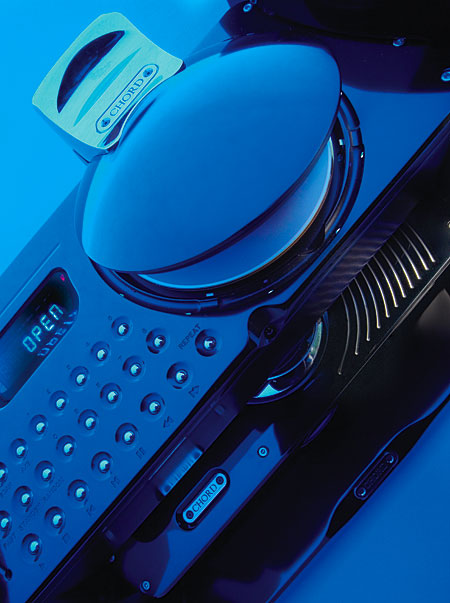
The top-loading Choral Blu ($10,400) has a large, spring-loaded clamshell disc cover dominating its right third, and an illuminated display set above 25 buttons to its left. Mirroring the Blu's look, the Choral DAC64 ($5000) has a "porthole" lens over one of its circuit boards. To the porthole's left, two arcs of six holes each are bored into the chassis like open parentheses. The Choral 2HIGH rack ($2100) holds the Blu and DAC64 stacked, um, two high—and canted at a 30° angle.

As striking as all this is, it's what's inside that's really fancy. The transport is a Philips CD2 powered by a switch-mode power supply that has its own AC filter. The Blu can upsample digital signals to 88.2kHz or 176.4kHz before sending them to a Watts Transient Aligned (WTA) filter. Chord says it has taken them 20 years to develop the WTA filter—and to figure out why higher sampling rates sound better. "It's not ultrasonic information," said John Franks. "If it was that, then 768kHz recordings could not sound better than 384kHz recordings—there's no information above 200kHz that could even be captured by our recording equipment."

There's a problem with upsampling to 176kHz, however: the S/PDIF pipeline can't accommodate a datastream that dense. Chord solves this by outputting each channel on its own BNC-terminated S/PDIF link. There are also AES/EBU and optical outputs. You can set dither to 16 or 24 bits, and there is a word-clock option, should you happen to have one in your system. (I don't either, but Chord sells a lot of gear to recording studios, so it's there if they need it.) The DAC64 can accept digital signals at 44.1kHz, 88.2kHz, or 176.4kHz. (JA reviewed an earlier version of the DAC64 in July 2002.)

So what are the benefits of high sample rates?

"What we're hearing is better resolution of transient information, which is something that human beings have evolved to being very good at detecting," said Franks. "A sampling rate of 1MHz would be ideal for capturing this, but it can be done at 44.1kHz with digital filtering—as long as you have sufficiently long tap lengths."

Beg pardon?

"Reconstruction filters generally have short tap lengths—the longest manufactured is only about 256 taps. We've constructed field-programmable gate-arrays (FPGA) that are 1024 taps long, which suggested that infinite tap length would produce 'indistinguishably perfect' sound quality. More practically, we developed a WTA filter with a 64-bit DSP core."

But wait, isn't there a WTA filter in the Blu, too? Yup—they built it, they're gonna use it. The DAC64 then sends the signal to a pulse-array DAC, which applies 64-bit seventh-order noise shaping and 2048x oversampling with "improved pulse-width modulation elements."

I was reeling at all the information I was downloading from Franks—my mind needs a bigger buffer.

"We'll get to the buffer, but first I need to expand upon that 64-bit DAC environment," Franks said. "A 16-bit input multiplied by a 16-bit coefficient gives you a 32-bit output. By using a 64-bit filter and architecture we avoid having to throw away information by truncating the output—something that becomes important if a digital volume control is used.

"Now we get to that buffer. Because we use all-digital data extraction, we can employ a RAM buffer to sequentially accept all the data, re-time it, and then output it. It gives us a jitter-free local clock, without requiring us to send a clock signal back to the source device. All of this takes place in Xilinx Virtex FPGAs, which offer 200,000 gates per device."

I must have looked puzzled. Franks had delivered all of this before my second cup of coffee of the day.

"That means we can change the entire design simply by updating the EPROM. It's state-of-the-art now, but if it ever isn't, we have the technology to fix it."

Franks is British. He couldn't have been teasing me by quoting the opening to The Six Million Dollar Man.

It goes like this: the fourth, the fifth
Setting up the Choral Blu-DAC64 combo isn't exactly rocket science, but you do have to take care of a few housekeeping matters—once, and then they're done with. The 2HIGH rack comes in three pieces, which are secured to one another with six bolts. The slots that the Blu and DAC64 slide into are lined with felt; the fit is snug, but there's no metal-to-metal contact.

Because I wanted to use the 176.4kHz link from the transport, I set the Blu's three-position clock switch to the proper setting (down) and connected the transport to the DAC64 with two van den Hul-supplied BNC-terminated S/PDIF cables. I set the DAC64 to receive data from its S/PDIF inputs and set the buffer to maximum (4–5 seconds). I did try the minimum setting (2–3 seconds) and Off buffering settings, but felt the small improvement in solidity and three-dimensionality offered by the maximum buffer was worthwhile—so I went for it.

A note about the jet-black finish: It's gorgeous, but forget about reading the text engraved on all those tiny buttons. Fortunately, everything is recapitulated on the Blu's hefty remote, but even after weeks of use, I found it impossible to remember which button controlled what, other than Play, Stop, Forward, and Back.

I also never cottoned to the "disc interface," at least when it came to removing discs from the well. Putting discs on the spindle was pretty straightforward, but removing them required pressing down on the upmost part of the disc, which tilted it, allowing you to get a finger under its forward lip. It felt awkward, even if it wasn't—and it punctured any fantasy about being pampered by the luxurious Chord kit. In other words, it felt like work.

I wasn't wild about the disc-removal process with the Oppo DV-970 I reviewed in May either, but at $159 I expected an ergonomic glitch or two. Strangely enough, I'm less forgiving at $15k.

Your faith was strong but you needed proof
Attention Screen's Live at Merkin Hall (CD, Stereophile STPH018-2) got a major workout on the Choral system. John Atkinson was mastering it when I first received the Chord combo, and he sent several generations of that my way, as well as the final-production CD as the review period drew to a close. Attention Screen's use of dynamics and tonal shading made it excellent audition material, but two elements kept me coming back for more: the phenomenal sense of space the Chord extracted from the discs, and the rock-solid physicality of the sounds of the instruments.

"Blizzard Limbs" is perhaps the track most filled with silence on Live at Merkin Hall—there's lots of "white space" between the notes—and the song illustrated one of the Chord's best qualities. Musical tones don't have a physical component, of course, but tones don't exist by themselves, except on recordings. In the real world, tones aren't just notes; they're shaped by the vibrational qualities of the instruments that produce them and the spaces in which they're produced. You're not hearing that guitar string, or that snare-drum head, or that piano; what you're hearing are those things amplified by the drum body, or amplifier cabinet, or sounding board as well as the hall they were played in. So while the vibrations themselves don't have a body, they're so influenced by the physical elements that produced and contained them that they do have the presence of something solid.

The Chords got this better than just about any other "Red Book" player I've heard. "Blizzard Limbs" begins with drummer Mark Flynn's rock-solid beat, joined by Don Fiorino's crunchy guitar chords, and finally joined by Chris Jones's Martian fretless bass guitar—all weaving in and out of the Merkin acoustic like threads passing over and under one another in a loom. Bob Reina's piano begins by adding just a little emphasis to phrase endings, before working its way through the warp and weft.

It wasn't reconstruction, however, it was re-creation. It was sonically convincing, not just in timbre and texture, but in its presence.

Oh yeah—and it flat-out rocked.

The title track of Ojos Negros, by Dino Saluzzi and Anja Lechner (CD, ECM 1991), like Live at Merkin Hall, carves long swathes of melody out of silence, but here the dynamic range is less extreme. The notes are not so starkly drawn against the acoustic, but remain very close to its baseline. Many CD players seem to have more trouble delineating such minute dynamic shadings, but not the Blu-DAC64 combo. While clearly delivering the timbral similarities of Saluzzi's bandoneán and Lechner's cello, it did an even better job of celebrating their differences. Because the two musicians delight in mimicking one another's tone and completing each other's phrases, this was especially welcome.

Welcome? No, vital was more like it. And the Chord combo's ability to deliver that life essence made a huge difference between my liking the music and my surrendering completely to its passion.

. . . yes and how he kissed me under the Moorish wall and I thought well as well him as another and then I asked him with my eyes to ask again yes and then he asked me would I yes to say yes my mountain flower and first I put my arms around him yes and drew him down to me so he could feel my breasts all perfume yes and his heart was going like mad and yes I said yes I will Yes.

I think I need a cigarette.

Tierney Sutton's "Sometimes I'm Happy," from her On the Other Side (SACD, Telarc 63650), is far more closely miked than either of the other discs, but engineer Robert Friedrich still captures tons of room detail under Sutton's sexily slurred vocals and Trey Henry's power bass. It's Ray Brinker's crisply moving drums that really grabbed me, however. Such speed, such palpability, such U-R-there-itude! Once again, it wasn't so much about sound, but about sound's body.

But now you never show it to me, do you?
In the May Stereophile I reviewed the Nagra CDP ($15,000), which impressed me as one of the best pure "Red Book" CD players I have ever heard. In both price and intent, it seemed the perfect, um, analog to the Chord Blu-DAC64. Both offer impeccable fit'n'finish; both aspire to the state of the art.

I connected the Nagra and the Chord Choral combo to both my Ayre K-1xe preamplifier and the HeadRoom Max Balanced headphone amp with Shunyata Altair Helix balanced cables. I use AKG's K 701 headphones in balanced mode for headphone comparison. Once again, I praise the Nagra's flexibility: Being able to choose its high-gain option for use with the Ayre and its lower-gain output for the HeadRoom Max Balanced made meaningful comparisons easier.

On Tierney Sutton's "Sometimes I'm Happy," the Nagra CDP revealed a bit more snap in Ray Brinker's brushwork. There was a bit more rat-a-tat-tat and sparkle, although the Chord gave more heft to Trey Henry's loping bass lines. Each player captured one or two things better than the other, but I wouldn't say either convinced me that the other got much wrong.

On "Ojos Negros," however, I felt the Chords better delineated the line between being and nothingness. The sounds of Saluzzi's and Lechner's instruments emerged from the room acoustic more fully formed, more rounded, more three-dimensional.

My listening notes refer consistently to "breath." It was only while attempting to reconcile the idea of "breath" with my impression of sonic palpability that I realized that breath may be only air, but it implies that there's a body somewhere doing the breathing. Holograms don't breathe; bodies do. So did the Chords.

That sense of bulk, heft, presence, or palpability captivated me with the Attention Screen disc as well. The Nagra left nothing out, but the Chord combo simply put more muscle on the skeleton—without sacrificing any suppleness.

The more I listened to the Blu and DAC64, the more they reminded me of something. While pondering On the Other Side and Live at Merkin Hall, I realized what it was: the sound of high-resolution digital, such as the Sutton SACD or the Attention Screen 24-bit/96kHz raw DVD mixes JA had burned for me. So I listened to those discs on my Ayre C-5xe. It might not be a completely fair comparison, but I did wonder how the higher-rez stuff would compare to the full Chord press.

It was impressively close. Through the Ayre, the Sutton disc might have had a shade more liquidity, fewer sharp edges—or maybe not. The SACD and CD were more alike than different. The Ayre pulled a few more dB of subjective dynamic range out of the Attention Screen DVD than the Chord extracted from the production CD. Maybe it was just 0.5dB—the swings seemed wider, but just a bit.

Does this mean that the Chord combo's upsampling, oversampling, reconstructive filtering, buffering, and gate-arraying turned "Red Book" into something better? I can't say—it's possible that the "Red Book" spec really is as close to theoretically perfect as, all those years ago, it was pitched to us as being. If that's the case, I haven't heard anyone get as close to that potential as Chord has in the Choral Blu and DAC64.

Or perhaps with all that shaping, shifting, and prodding, Chord has happened on precisely the right combination of euphonic colorations to compensate for my perceptual deviations from perfect. It strikes me as unlikely—but then it would, wouldn't it? No one thinks of himself as a bad listener any more than anyone thinks of himself as a bad lover.

But it does suggest that the Chords might constitute the universal player so many audiophiles have been waiting for. No, the Choral duo doesn't do SACD or high-sample-rate DVD, but let's face it, not all that many such discs are available to us, whereas we have a quarter century's worth of "Red Book" discs that the Chord components can make sound awfully darned good.

And every breath we drew was Hallelujah!
At $15,400 ($17,500 with stand), the Chord Choral Blu transport and Choral DAC64 digital processor don't comprise the most expensive digital rig I've reviewed, but the price does make me gulp a bit. The fact that I can't afford the Blu-DAC64, however, doesn't make me think them unreasonably expensive. To see these components—and to discuss with John Franks the details of their construction—is to immediately understand that they are handmade to an exactingly high standard.

You know if you're one of those who can afford to buy the Chorals. The question is, should you? Only if you've been looking for a CD player that can justify the last two decades of recording technology. To my mind, the Choral Blu and DAC64 are, together, the CD player we music lovers have long prayed for.

Hallelujah!

Related Links...

Read More...

Naim CD555 CD player

Naim CD555 CD player 
HI-FI, Sterio, Home Theater, Audiophile, Amplifier, Speaker

Naim's new "statement" CD player, the CD555 ($20,300 by itself, $28,150 with PS555 power supply), breaks no new technological ground. Rather, in typical Naim fashion, it attempts to optimize 16-bit/44.1kHz CD performance by paying fanatical attention to the devilish details. It doesn't play the DVD-Video, DVD-Audio, or SACD formats, nor does it have a digital output—and it doesn't create an illusion of higher resolution by upsampling the data.

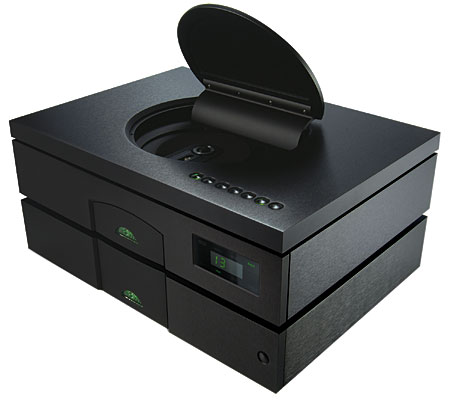
Encased in an almost forbiddingly heavy, precision-milled box of black aluminum with edges that are almost sharp as razors, the CD555 exudes all the mystery of some Fortress of Solitude. Two multipin cables made by Burndy—one each for the analog and digital circuits—connect the CD555 to the 555PS power supply ($7850), which is another dense, sharp-edged brick of black, brushed aluminum. The 555PS can be used with any Naim CD player made from 1998 to the present day. It has seven regulated power supplies, five secondary transformer windings, a 40% larger transformer than its predecessor (Naim's XPS2), and a low-resonance case with isolating feet.

The CD555's motorized, top-mounted disc door runs silently and smoothly, and seals tightly to shut out ambient light. Its clamshell design replaces the swing-open, front-mounted disc drawers of earlier Naim players. If you set the CD555 by itself on a lower shelf of an equipment rack, you'll need a between-shelves distance of about 9" for the door to clear. The disc transport itself is a Philips Pro with a diecast chassis; it resides in a heavy, machined tray designed to reduce resonances. Paint that minimizes the reflection of infrared light coats the tray area to reduce interference from stray light from the player's laser.

Pacific Microsonics' PMD200 chip handles digital filtering, which means the CD555 will recognize and decode HDCDs, while vintage (ie, introduced in 1998) Burr-Brown PCM 1704 DACs convert the digital signal to analog. There's a separate, triple-regulated, low-jitter clock circuit with its own multistage regulated power supply, sourced from a transformer secondary winding, and a post-digital filter circuit that Naim says virtually eliminates jitter.

Discrete components handle the current-to-voltage conversion, seven-pole analog filtering, and analog output stages. The digital circuit boards are made with surface-mount technology, the analog boards with the more conventional "through-hole" construction.

Three independent leaf-suspension systems, each tuned to a different frequency, isolate the analog and digital board assemblies and the CD tray. In designing the separately suspended analog and digital assemblies, Naim situated the analog-regulation board below the one that handles the analog signal in order to maintain a stable operating temperature. On the digital side, the regulation board is over the signal-processing board because that arrangement results in the most stable operating temperature. The DACs are mounted in what Naim calls a "quiet room"—an environment shielded to prevent varying electrical and magnetic fields from interfering with the DACs' performance.

The cost of all of the engineering tweaks, the superb, bulletproof construction, and Naim's Apple Computer–like first-class industrial design, is $28,150. Do the CD555 and 555PS add up to a significant improvement in CD sound? Or is Naim merely repolishing their already established, admittedly impressive take on what most listeners acknowledge to be the compromised resolution of the "Red Book" CD standard? More than 20 years after the launch of the Compact Disc, are there any more data still to be extracted from a sound format of inherently limited resolution? After all, you can't get a 480i-resolution monitor to display a 1920x1080p high-definition picture no matter what you do, and CD's measured and sonic performance has already come a long way since the format's introduction. What's left to improve? The question is not rhetorical.

Setup and Use
Before the CD555 can be used, the transport screws used to secure the three suspension systems must be removed—without turning the heavy player over. That requires hanging it off the side of a table or other platform from various angles in order to gain access to all seven screws. Then, moving the player to its final destination results in a loud clatter as its heavy brass subassemblies bang around inside, even if you try to keep the player level. No harm done, but it's best to remove the screws as close as possible to where the player will permanently sit.

Speaking of sitting—if you do place the CD555 on a lower and/or poorly lit shelf, you'll find that its controls won't light up until you activate one of them, either directly or via the rugged remote control, with its illuminated LCD screen. Ditto the lack of illumination in the CD well itself, where you might find yourself fumbling in locating the spindle, and in placing the magnetic CD clamp atop it once the disc is in place. But all of these are minor inconveniences; I suspect most buyers will place the CD555 on a top shelf—where, indeed, such a top-shelf product deserves to reside.

Naim includes both RCA and DIN analog outputs, selectable via a few button-presses on either the remote or the player. You can use both outputs simultaneously, but Naim says the player won't sound as good that way, so don't. Naim supplies a set of DIN-to-RCA interconnects, which I used during the break-in period and for my initial listening. However, in order to remove one unknown variable, I eventually switched to a set of TARA Labs The Zero interconnects fitted with RCAs. The resulting sonic improvement was enormous, and as described in my review of The Zero in the December 2006 Stereophile. A cable that handles attack, sustain, and decay as effectively as The Zero does well serves Naim's signature sound, as described in the next paragraph.

Listening
Virtually everything in my system has changed since I last reviewed a Naim CD player: the CD5, in April 2001 (footnote 1). Since then too much time has passed for me to make any comparisons, but the CD555 delivered all of the sonic attributes for which Naim is known: taut, punchy bass, rhythmic agility, transient clarity, exceptional resolution of low-level detail, and overall transparency. Like other Naim CD players I've heard, the CD555 managed all of this without sounding etched, bright, or harmonically bleached, and delivered weight and body while never sounding "zippy." Yet its overall tonal presentation was definitely cooler and less voluptuous than that of the Zanden pair, even as its bass extension and punch were deeper and better controlled.

At a presentation I did last October at Seattle dealer Definitive Audio, recording engineer Matthew Gephardt came by to listen and give me a CD he'd engineered: bluegrass mandolin player Chris Thile's How to Grow a Woman from the Ground (Sugar Hill Sug-CD-4017), recorded at New York's Sear Sound using a Forssell Technologies mike preamp and two vintage Telefunken ELA M251E microphones in spaced-omni orientation. You need to hear this disc. I'd not heard it on any other player, but via the CD555, the quintet's spatial presentation was intensely three-dimensional, vibrant, and whole; the band's rhythmic and dynamic delivery were cleanly rendered and breakneck exciting, if tonally somewhat on the cool side.

At last fall's Hi-Fi News show at Heathrow Airport, I picked up a used copy of an early-1970s pressing of the Elgar Cello Concerto with cellist Jacqueline Du Pré, and John Barbirolli conducting the London Symphony Orchestra (LP, EMI ASD655). I also have the same performance on CD (EMI CMS 7 63282-2). When hack film composers want to show a scene of war's devastation or some other unpleasantness, they reach for the aching melody of the first movement and it works like a charm. I heard the concerto performed live at Avery Fisher Hall last year, and damned if I didn't catch "a cold" a few minutes in.

On vinyl, when Du Pré bows her instrument, my heart breaks. On CD, I merely take note (in this case, literally). The massed strings melt in my ears via vinyl; via CD, they merely tickle. In an A/B comparison, the hall alternately appears (LP) and disappears (CD). (In all fairness, so do some pops and ticks.) That's just the way it is, whether you spend $2800 or $28,150 on a CD player—which is not to fault the Naim CD555-555PS. In fact, the Naim pairing's rhythmic and dynamic agility and low-level resolve made its rendering of this recording quite involving and attention-grabbing, if somewhat harmonically reticent compared to the Zanden player that I reviewed last November, which costs nearly twice as much and measures only half as well (though the latter is probably a bit of an exaggeration).

So rather than compare CDs to LPs, I thought it more worthwhile to compare the CD555 to Musical Fidelity's two-box kW DM25 transport and DAC, which Art Dudley reviewed in July and which sells for a comparatively modest $6500.

I keep worrying that my enthusiasm for TARA Labs' The Zero interconnect is delusional, Pavlovian, or whatever, so I began with another brand of interconnect between the kW DM25's solid-state output and my preamplifier, and TARA The Zeros between the Naim and the preamp. Armed with two copies of the Chris Thile CD, I began my A/B comparisons.

No contest. The Naim's bottom-end control, instrumental focus, soundstage clarity, transient speed, and overall tunefulness simply outdid the Musical Fidelity. I then compared two CD-R copies of mostly acoustic tracks I've compiled from various LPs. The results were similar.

Then I leveled the playing field with a pair of TARA Zeros going to the Musical Fidelity CD player and began listening again to the CD-R compilation, which ranges from Don Henley's "End of the Innocence" to the Grateful Dead's "Uncle John's Band," Joni Mitchell's "Cold Blue Steel," Clive Gregson and Christine Collister's devastating "I Specialise," Nanci Griffith's " I Don't Want to Talk About It," Arlo Guthrie's "Down in the Valley," and Peter Case's magnificent-sounding "Put Down the Gun," among others—in short, enough dynamic, tonal, and spatial variety to let me know what was going on. Yes, there was still a difference, but it was now almost imperceptible. I feel confident that most casual listeners would say that the two players sounded virtually identical in terms of every item on a checklist of audiophile playback parameters. However, most audiophiles are not casual listeners and for the serious listener, the improvements in bass weight and control, high frequency transient resolution and spatial focus out to the very back and corners of the soundstage might be worth the asking price

When I listened with great concentration for any hint of sonic signature, the Naim exhibited slightly tighter overall control and spatial focus, had a little less congestion and greater weight in the bass, and slightly better transient resolution at very high frequencies—all areas in which Naim gear is known to excel. For instance, Nick Lowe's "Cruel To Be Kind" is equalized with a ludicrous amount of top-end information, which accentuates guitar strums, tambourine hits, and Lowe's sibilants—all of which the Naim CD555 rendered with slightly greater precision and clarity, without any added hardness or stridency. The Musical Fidelity kW DM25 reproduced the tambourines with less resolution and more clatter.

Overall, however, the two players were more alike tonally, spatially and harmonically than they were different. We're not talking about transducer-type differences so that depending on the source material, these differences could be significant or inconsequential. The biggest and most consistently noticeable differences, regardless of source material, were in image solidity and size, soundstage focus, and overall musical control—all Naim signature sonic attributes. In the A/B contests, the Naim always won but usually not by a large amount. However, one of the reasons we tend to reject "A/B" tests is because we listen over time, not for short bursts, and over time the 555 proved its value. Switching to other brands of interconnect—for instance, Shunyata Research's smooth yet detailed Antares Helix—changed the overall characters of both players, but I could still hear the same slight differences. The importance of those differences was determined by the musical content and recording quality.

The recently resurrected Reference Recordings has just issued their 30th Anniversary Sampler HDCD (RR-908). I compared the Naim's HDCD signal with the Musical Fidelity's non-HDCD signal, upsampled by the player to192kHz. I didn't hear enough difference in resolution to write about, but the greater image solidity, focus, and all the other Naim specialties were still evident from the CD555, though still bettering the MF's performance by only a hair.

Conclusion
Value is almost impossible to define. Is the Naim CD555's more refined sound worth the $21,650 difference in price between it and the kW DM25? In the highest strata of audiophilia, small incremental sonic improvements seem to cost more as you near the limits of what's possible, or what was previously considered possible. Like other companies playing in the 16-bit, 44.1kHz playground, Naim has probably reached the limits of what's possible with the format. Getting there required the expenditure of a great deal of time, effort and money and the results do speak for themselves. I can't say listening was a "mind blowing" experience, but it was certainly the best CD sound I've heard other than that of the mediocre-measuring and twice as expensive Zanden. Call me a "distortion lover."

That said, the CD555 was the best solid-state CD playback that I've heard and while the differences between it and a far less expensive CD player seemed minimal in the short run, I imagine that a music lover with a big collection of CDs and a bank account to match will find his long term listening pleasure intensified to a degree that would make such a purchase well worth the investment. And then there's the exceptional engineering, meticulous build quality and attention to detail that went into its design and manufacture. It's difficult to put a price tag on that, but Naim had to and that price tag is $28,150. Only you can determine if the CD555 is worth that much scratch.


Footnote 1: Art Dudley reviewed the Naim CD5x in November 2004, with a follow-up in November 2005.—Ed.

Related Links...

Read More...

Muse Polyhymnia universal player

Muse Polyhymnia universal player Muse Polyhymnia universal player Muse Polyhymnia universal player Muse Polyhymnia universal player Muse Polyhymnia universal player Muse Polyhymnia universal player Muse Polyhymnia universal player Muse Polyhymnia universal player Muse Polyhymnia universal player Muse Polyhymnia universal player HI-FI, Sterio, Home Theater, Audiophile, Amplifier, Speaker

"I have something I think might interest you," said Elite AudioVideo Distribution's Scot Markwell. "Kevin Halverson has some, shall we say, different ideas about universal players."

We walked into Elite's dark demo room at last year's Consumer Electronics Show and Markwell stepped aside with a flourish, gesturing toward a quasi–industrial-looking, powder-coated box: the Polyhymnia universal disc player, from Halverson's Muse Electronics.

"Ta-daa!" Yes, he said it.

I must not have looked impressed. "Oh, I forgot," he said. "It's only fancy on the inside." And—as he quickly demonstrated—in performance.

Markwell cued up an SACD and pressed Play. It was like that hackneyed scene when the prim librarian takes off her glasses, shakes out her coiled hair, and stares into the camera. She is drop-dead gorgeous, after all.

Hubba, as they say, hubba.

Love passed, the muse appeared
Polyhymnia is the Greek muse of sacred song and lyric poetry, and the inventor of the lyre and harmony. Her name literally means "(singing) many songs," so it's an appropriate name for a universal disc player. The Muse Polyhymnia (as opposed to the muse Polyhymnia) is one of Muse's Modular Audio-Video Platform (MAP) components, which means that its four bays allow the end-user to add the features he or she might require. The Polyhymnia sings "Red Book" CDs, DVDs -Audio and -Video, SACDs, and MP3-encoded discs in two channels, with multichannel playback available as a separate $750 module.

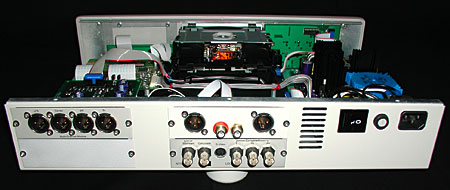
My review sample, which Scot Markwell called "standard" in that it included the Ultra Performance analog output module and RCA and XLR stereo outputs, also included the optional multichannel output module (RCA), and an A/V output module (S/PDIF, S-video, composite video, component video). The fourth bay was empty, although a variety of choices, including an attenuator module, can be included. Price of the standard stereo model: $6400.

I said that the Polyhymnia's glamour resides within, but that's not to say it doesn't have its own kind of lab-gear butchness. A powder-coated case may not be as sexy as an anodized one, but the Polyhymnia is built like a brick and screams dependability. Think subdued Harley-Davidson: no chrome, lots of grunt.

The Polyhymnia is the sixth generation of Kevin Halverson's take on DVD. In fact, when Classic Records decided to take advantage of DVD's 24-bit/96kHz spec back in the format's infancy, it was Halverson who brought the news to Stereophile in Santa Fe: "Don't you get it? For the first time, audiophiles can actually own studio-quality masters!"

DSD and PCM are both handled by native conversion, using a passive reconstruction filter (a high-order Bessel topology) and, Halverson says, "a highly differential instrumentation-amplifier signal path. We find that this topology has the advantage of reduced spectral contamination and a low and spectrally flat noise floor."

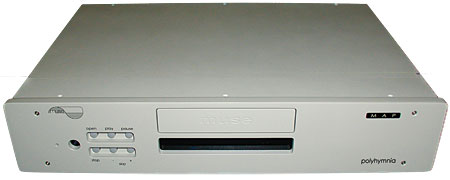
The Polyhymnia's front panel looks almost bare. There's an IR window, two rows of three control buttons each, a disc tray, and a small illuminated display. Although a video display isn't required for day-to-day use, some functions are a lot easier to access if one is present—and a display is essential for setup.

The Polyhymnia is accompanied by the largest, heaviest, most solidly constructed remote control I've ever encountered. It weighs about as much as a red-clay brick and seems as durable—an important consideration, as users will be overwhelmed almost daily by the urge to hurl it against something solid.

Why? Because the Remote-2 has 64 buttons, all exactly the same size, many of them labeled cryptically in light gray letters on a slightly lighter gray background. I also found the buttons fiddly—or maybe it's the IR window. All I know is that the Polyhymnia ignored an awful lot of my commands. (Markwell tells me a much simpler remote for the Polyhymnia, called the Remote-1, which is easier to navigate, is now available as a $375 option. Seeing is believing.)

One additional note: The owner's manual states that "The Polyhymnia should never be connected to a mains source (power outlet) other than the normal domestic service. After market 'power conditioners' of the active variety (regeneration devices) can damage your Polyhymnia and should never be used." Now you know.

Fool, said my muse to me
Before setting up the Muse Polyhymnia, eat a substantial breakfast, preferably accompanied by enough caffeine to wake you thoroughly without giving you the jitters—those remote buttons are small and require a firm and accurate touch. Hook up your video display and be prepared for a trial by menu. You'll need to tell the Polyhymnia how to handle digital audio output (including Dolby Digital, DTS, linear PCM, MPEG, and video). If you're integrating the player into an A/V system, you'll need to establish the aspect ratio and assign S-video or component pathways. There are submenus for DVD playback mode (DVD-V or DVD-A) and DSD playback (two-channel, multichannel, or CD layer). There's a DTS downmix submenu, as well as an option to constrain the dynamic range of your discs (some people actually want this, believe it or not). There's more, but you get the idea.

Of course, one reason you have so many options is that the Polyhymnia can do so many things. I just set it up to play two-channel CD, SACD, and DVD-A. Then the video display went bye-bye. It turned out to be true that you don't need a display to play discs—unless you change your mind about whether you're listening to DVD-A only. If you want to hear the soundtrack on an occasional DVD-V, you'll need to fetch the monitor again and leave it there so you can switch the Polyhymnia back to DVD-A afterwards.

Livelier liquor than the muse
The Polyhymnia's On/Off switch is on its rear panel. For daily use, the player is left on; it lapses into Standby mode after about an hour of inactivity. And you might as well leave it on, because it sounds better after it's been on for a few hours. I offer no explanation for this, but I observed it every time I shifted the Polyhymnia from one system to another.

As a CD player, the Polyhymnia impressed me from the get-go. Chickasaw County Child: The Artistry of Bobbie Gentry (CD, Shout! DK-32278) was a revelation. Joan Osborn said that Gentry's voice is to women's voices as Sophia Loren's curves were to women's bodies: the epitome. The Polyhymnia captured that hyper-femaleness, setting it within baroque soundscapes that had width, height, and, most of all, depth. The bottom end was impressive, as was the top-end sparkle.

John Coltrane's Settin' the Pace (CD, JVCXR-020202) put a big tenor sax in the center of my room, spitting overtones at the walls as forcefully as, well, me spitting watermelon seeds at June bugs (it's good clean fun, trust me). The revelation, however, was the brilliance of Art Taylor's cymbals—they had a shimmer and a sizzle that approached live music.

Yes, the Polyhymnia was a very good CD player.

Its playback of DVD-Audio discs was also impressive. Generally, I prefer SACD, if only because DVD-A seems to force you to have a monitor in the system to pick a mix or a bass setting or some damn thing, and that crap just gets on my last nerve. However, having already told the Polyhymnia what to do when I set it up, now all I had to do was hit Play twice and listen to my DVD-As. I'd forgotten how good they can sound.

"Janie Runaway," from Steely Dan's Two Against Nature (DVD-A, Giant/Reprise 24719), had a slamming bottom end set against a sparsely populated band and those ethereal Steely Dan vocals. Everything was so well presented that I got lost in the detail: "Let's grab some takeout from Dean & DeLuca / a hearty gulping wine / you be the showgirl / I'll be Sinatra...Come to ol' blues eyes and tell me—who do you love?"

Hmmm. I think I liked that song better before I understood the lyrics.

However, there was no questioning the glory of Joni Mitchell's "A Case of You," from Both Sides Now (DVD-A, Reprise 47620). Oh, the smoky resonance of her voice, the silky strings, Wayne Shorter's vivid soprano-sax solo—has any promising youngster ever matured so thoroughly into a true artist as completely as has Mitchell? Curse you, DVD-A consortium, for screwing up this format so completely that I could have spent years without hearing this disc—and curse me for holding the format itself against such beauty.

SACD was impressive, too. Tierney Sutton's The Other Side (SACD, Telarc SACD-63650) had presence, body, and a silvery top end. Joe Beard's Dealin' (SACD, AudioQuest AQ-SACD1055) was all bluesy bluster, from Beard's propulsive guitar to Jerry Portnoy's blown-out mouth harp. And David Russell's Art of the Guitar (SACD, Telarc SACD-60672) was convincing in its three-dimensionality and delicacy.

Why does my muse only speak when I am unhappy?
My reference universal player, the Ayre C-5xe ($5995), seemed a logical benchmark for the Polyhymnia. The Ayre has no video output and is focused solely on two-channel audio, so the Muse does offer features that may tempt listeners who want to use the Muse in a multichannel or A/V system—and, of course, the Muse's modular platform makes it simple for any consumer to configure to his or her requirements. On the other hand, the Ayre's two-channel, audio-only focus made it so much simpler to use—which meant that my neighbors weren't disturbed by the foul language I invariably spat at the Muse when it didn't do what I thought I'd told it to. I'm sure most Stereophile readers will do a better job of mastering that blankety-blank remote than I did—or perhaps Muse's new "streamlined" remote will solve this minor annoyance.

The Ayre and Muse were more similar than different in their reproductions of CD sound. If the Muse had brisker pace and a tad more oomph on Bobbie Gentry's "Okolona River Bottom Band," the Ayre had greater air and breath on "Morning Glory." Perhaps the soundstage was larger with the Polyhymnia, but the Ayre's tighter focus was just as impressive. If pressed, I'd probably dance with the one what brought me—I'm used to the Ayre—but you might choose differently.

The Muse's brawn made Coltrane clearly the star of Settin' the Pace, burnishing his brash brass with a special luster, although the Ayre presented more of Art Taylor's cymbal overtones.

On Steely Dan's "Janie Runaway," I was again impressed by the Muse's slam and low-end power, but the electric piano and guitar sounded somewhat leaner and less present than when played through the Ayre. The C-5xe was a tad more laid-back. Your preference might well hinge on which you value more: energy (Muse) or coherence (Ayre).

Joni Mitchell's "A Case of You" also revealed each player's strengths. The Polyhymnia had great momentum and the frequency extremes were superbly delineated, although the Ayre gave Mitchell's voice an extra dose of smoky breath. Through the C-5xe she was more prominent, while the Muse emphasized the instruments more. Well, a bit more—at this level, we're speaking of minor differences.

Through the Ayre, Tierney Sutton's voice in "Haunted Heart" had a touch more air, especially her head tones. Overall, I'd say voices had a touch more "glamour" through the Ayre. Again, the Polyhymnia's presentations of detail and separation were superb, whereas the C-5xe emphasized blend over detail.

That's one reason Joe Beard's Dealin' had such drive and rhythmic energy through the Muse. It flat-out rawked. The Ayre was a touch more restrained, although its more tightly packed soundstage was almost as impressive as the Muse's larger one.

David Russell's Art of the Guitar had a plummier midrange through the Muse, which was a surprise. The Ayre's timbre was somewhat leaner, and it presented more string noise than the Polyhymnia. On the other hand, the sense of a small instrument in a large, reverberant acoustic was greater with the C-5xe.

Did one player come out a clear winner? Actually, they both did—though I know some readers will think that's a cop-out. The fact is, I could live happily with either, especially without having the other one around to do A/B comparisons all the time. For slam and impact, the Muse would be my choice. For vocals and coherence, it would be the Ayre, probably.

Be thou the tenth Muse
It's not just either/or, however. Many factors go into choosing a universal player, and the Muse Polyhymnia is definitely a contender in the high-end universal-player sweepstakes. It's solidly constructed and meticulously designed. Its modular platform allows consumers to put it together to precisely match their requirements, which is no small consideration.

My only quibble with the Polyhymnia—and this is a nit I'm picking—was that I disliked its large Remote-2 control. Maybe that's a bigger deal for a guy who switches gear in and out of his systems all the time than it would be for a monogamous listener.

But given the Muse's performance with any type of digital disc I fed it, I'd be willing to forgive a lot more than an awkward remote. Under its utilitarian lid lurks one sexy, high-performance beast.

Hubba-hubba indeed.

Related Links...

Read More...

Esoteric SA-60 universal player

Esoteric SA-60 universal player 
HI-FI, Sterio, Home Theater, Audiophile, Amplifier, Speaker

In the ongoing debacle that has been the introduction and promotion of high-resolution digital audio and the record industry's struggles to engage the public's interest in it, two recent events stand out.

One was Sony's decision, in 2006, to limit to one day a week the production of hybrid SACD/CDs at its Terre Haute, Indiana pressing plant, which had opened with much fanfare in May 2003. That forced ABKCO Records to replace its catalog of Rolling Stones hybrids, perhaps the best-selling SACD/CDs ever released, with "Red Book" CD editions. According to ABKCO, the company had found itself unable to fill wholesale orders.

Removing the SACD layer wasn't a big issue for ABKCO—few consumers were buying the discs to get the SACD layer in the first place, the label had designed the artwork to underplay SACD to avoid consumer confusion, and, most important, had priced the discs to ensure that they'd be stocked in the CD racks and not in some "audiophile" ghetto hidden behind a wall. But Sony's move drove the last nail into the coffin of the optimistic notion that the hybrid disc's "hidden" SACD layer might make it a mainstream product costing no more than a "Red Book" CD. Sony's message, heard loud and clear throughout the industry, was that no independent label's effort to support the SACD format with superb sound, a popular catalog, and low prices would go unpunished by SACD's inventor and original promoter.

The other high-resolution setback was Philips' launch, in 2005, of a poorly designed, ergonomically primitive OEM SACD transport. Aside from refusing to play a large percentage of "Red Book" CDs that any $30 DiscMan would play without so much as a digital hiccup, this transport eventually produced an almost 100% failure rate in the field with no possible fix—much to the disgust, horror, and embarrassment of Krell, Musical Fidelity, T+A, and other makers of high-end players who value their reputations for making reliable, high-quality players. Philips then made matters worse by simply abandoning their manufacturer customer, leaving these companies to face angry customers who'd bought expensive products that broke and could not be fixed.

Add the problems in navigating DVD-Audio discs with displayless, audio-only systems, the limited enthusiasm among audiophiles for multichannel sound, the record industry's confusing move to double-sided DualDiscs containing CD, Dolby Digital, and DVD-A content, consumers' clamor for lo-rez MP3 downloads, and the resurgence of analog, and it's a wonder that hi-rez digital sound has survived at all.

Yet, like vinyl, high-resolution digital has survived, thanks to the support of enthusiasts like the readers of Stereophile. A perusal of retail websites catering to audiophiles demonstrates that there's sufficient high-quality music available in the two hi-rez audio formats to make the purchase of a "universal player" worth considering—assuming that that player offers superb CD playback. For now (and perhaps forever), the vast majority of digitally encoded music on disc will be in the standard "Red Book" format.

Proprietary VOSP transport
Esoteric's product line includes audio-only CD transports costing $13,300 and $25,000, and stereo and monoblock DACs costing $13,300 and $25,000/pair, respectively. At $4600, the SA-60 is second from the bottom of Esoteric's audio-only offerings, yet has a highly advanced, proprietary transport that Esoteric has developed, using the same optics, from the X-3 series of VRDS transports used in the company's more expensive players.
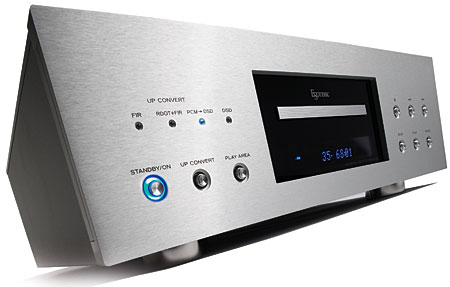
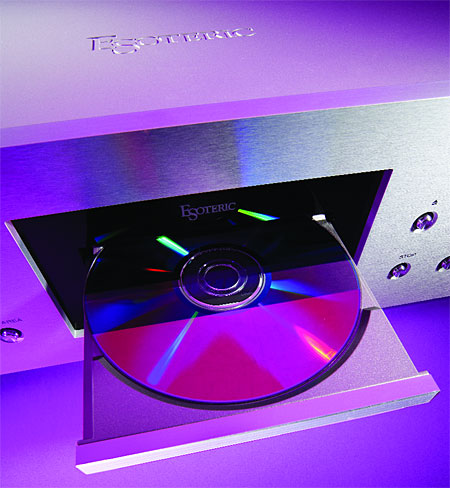
The mechanism—a sophisticated, Vertically Aligned Optical Stability Platform (VOSP)—is claimed to offer levels of rigidity and stability not found in cheaper plastic transports, as well as a high-mass disc-clamping system that reduces rotational resonances at high speeds. The disc is clamped between a plate and an 8mm-thick, large-diameter disc, both made of metal.

This rigid, stable framework permitted the development of a shaft-mounted laser-pickup assembly of equal rigidity and stability, that maintains perfect vertical alignment to ensure that the laser's optical axis is always centered in the data track. [According to the SA-60's manual, the actual optical pickup is sourced from Sony, an SLD6163RL-G—Ed.] Conventional laser-pickup assemblies are allowed to pivot in order to keep the laser beam in contact with the spiral data track. In cheaper transports, the high-speed rotation of the disc causes unwanted resonances that can shake both the disc and the laser head. According to Esoteric, data read when the laser is off its central axis is liable to high levels of jitter and errors. The VOSP transport's reduction of tracking error and claimed elimination of off-axis data reading are claimed to result in far less jitter and error correction.

The transport mechanism is mounted directly on the bottom of the chassis with a pair of steel brackets, to provide additional rigidity to further damp resonances. The disc tray itself is made of aluminum, not plastic. A picture of the VOSP mechanism speaks volumes about its robust mechanical design when compared to the typical plastic transports found in most CD, SACD, DVD, and universal players.

But how much difference can all of this mechanical stability and "perfect tracking" make to digital sound? Why should it make any difference at all?

Many audiophiles forget that an optical disc is actually an analog format—the digital code itself is not engraved in the disc. Instead, the disc's "land" and "pit" surfaces are physical analogs of the digital bitstream's ones and zeros. As the laser beam is reflected off a land or a pit, the amount of reflected light reflected determines whether the information is read as a one or as a zero.

A CD pit is intended to absorb light; the laser's "direct hit" on a pit is more likely to provide greater absorption of the beam, and thus a greater likelihood of the pit's being read correctly, than the "partial hit" of an off-axis strike (footnote 1). While error-correction circuitry can extrapolate and fill in missing data, better tracking should result in fewer reading errors, and thus less interpolation, less jitter, and better sound when the data is converted to an analog signal.

Digital Conversion
Once the SA-60's transport has read data from a CD, SACD, DVD-A, DTS, DTS 96/24, or Dolby Digital disc, it then feeds those data to the player's Cirrus Logic CS4398 digital-to-analog converters. These DACs are capable of natively converting the SACD format's native DSD encoding, as well as converting PCM data. (Some SACD players' DACs convert DSD to PCM before presenting it to the DACs.) In keeping with Esoteric's purist intentions, the SA-60 has separate DACs for its two- and 5.1-channel outputs.

The SA-60 employs the second generation of Esoteric's proprietary RDOT and FIR algorithms, which give the user a variety of reconstruction filters. The player also includes the option of upconverting CD PCM data to DSD, as used in Esoteric's far more expensive P-03/D-03 separates.

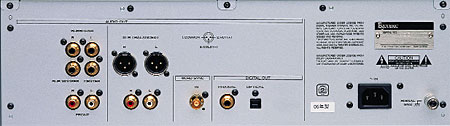
The rear-panel jacks include separate two-channel and multichannel outputs and a pair of balanced XLR outputs. There are also coaxial and optical digital outs, and a BNC word-sync input for use with an external word clock. (Esoteric offers several dedicated master-clock devices including one, the G-0S, which features a rubidium clock generator.) An optional iLINK (IEEE1394, or FireWire) port outputs DSD and high-resolution PCM, both stereo and multichannel, for decoding via an outboard DAC. The remote control, milled from a block of aluminum, exudes high quality, though it's not backlit.

All things considered, the reasonably priced SA-60 makes an unreasonably fine physical impression in terms of both build quality and functionality.

Setup and Use
Japanese-made components often come with frustratingly incomplete and/or confusing instruction manuals, and the SA-60 is no exception. For instance, its manual's "Up convert" section tells you that "An FIR digital filter...does upward sample rate conversion," and that you can "select wide or narrow characteristic for this filter. See page 20 for details." On p.20 you are told how to "Choose either 'Wide' or 'Narrow,'" but not a word about what that means, or what the sonic consequences of choosing either option might be.


Footnote 1: The depth of the pits on a disc's surface should be one quarter of the wavelength of the laser light, meaning that when read from directly above, there will be complete destructive interference with light reflected from the pits, but not the lands, maximizing the dynamic contrast. This contrast is reduced when the pits are read from an angle.—John Atkinson

Ditto the explanation for the DSD settings of "Normal (factory default)" and "Direct." The manual says that the "Normal (factory default)" setting outputs DSD "after processing," while "Direct" outputs the audio signal "without running it through the processor." You're given no idea what selecting either option means in terms of sound—an unacceptable "explanation," in my opinion. Buyers, especially those less technically adept and/or experienced, deserve better documentation.

Pressing the FIR button on the front panel automatically upconverts the "Red Book" bitword resolution of all sampling rates from 16 to 24 bits. Signals sampled at 44.1kHz are upconverted to 48kHz, 88.2kHz signals to 96kHz, and 176kHz signals to 192kHz. Pressing RDOT+FIR engages the second upconversion filter, which features a "slow rolloff curve for a more immersive sound." This feature deserves more explanation in the manual. Pushing a third button upsamples any PCM signal to DSD resolution (1-bit words at 64Fs or 2.822MHz).

Anyone who's set up a home-theater receiver will have no problem using the SA-60's logically organized menus. Others may struggle a bit. There are two sets of setup options: a relatively simple one for two-channel operation, and a more complicated one for multichannel that includes settings for speaker size and distance, plus a test tone.

With the exception of accessing what Esoteric calls "Group Areas" on DVD-A discs, or even understanding what the phrase means without some frustrating experimentation (thanks to the less-than-forthcoming manual; see below), using the SA-60 was a complete pleasure. The transport operated smoothly, and was quiet and responsive, as was the remote control.
SACD playback was straightforward. Having the option of choosing a hybrid disc's PCM or DSD layer by hitting the remote's Play Area button before hitting Play was a welcome change from the Philips transport mechanism in my reference SACD player, a Musical Fidelity kW, which doesn't permit that operation (and, in the near future, probably won't permit any operation).

Playing DVD-A discs without a video display to access the menus will never be easy. However, the SA-60 made this tolerable, once I got the hang of it. The instructions tell you to use the Group buttons to "change titles and groups on DVD media." Precisely what a DVD-A's "group" might be isn't specified, nor was it clarified when, in the "Selecting Playback" section of the manual, the user is told that pressing the Play Area button will select the "play area" of both SACDs and DVD-As. "Play Area"? "Group"? With no definitions or explanations of these terms provided, you're on your own.

Hitting Play Area while in Stop mode toggled between an SACD's DSD and PCM layers, but did nothing for any of my DVD-A discs. Pressing "Group" forward or back gave access to various audio options, including multichannel, stereo, Dolby Digital multichannel, and, occasionally, the audio tracks of video features whose images I couldn't see. Which Play Area was accessed by each press of the Group button depended on authoring choices made during the mastering of that particular release. Most DVD-As I tried gave me the multichannel mix as the default (Group 1), as confirmed by the speaker-channel icons (L, C, R, RS, LS, LFE) lit up on the front panel's fluorescent display. When the SA-60 is set up for two-channel operation, it automatically downmixes the multichannel mix to two-channel stereo, and the display announces "Downmix."

However, as I discovered when comparing the "downmix" and the two-channel track (Group 2) of the spectacular-sounding DVD-A of Neil Young's Harvest (Reprise 48100-9), the downmix didn't necessarily produce acceptable stereo—the downmixed Harvest had grotesquely bloated bass (ever heard someone knocking over a mike stand in the right channel two minutes into "Out On the Weekend"?). So when playing a DVD-A in a two-channel system, be sure to search for the stereo mix (if any). As I switched among Groups, which can be done on the fly during playback, I needed patience: the SA-60's display reflects a change in Group only after the next Group has been accessed, which can take some time. When I lost patience and hit Group again, I ended up in Group 3.

Some DVD-As, such as Queen's A Night at the Opera (Hollywood 69286-01091-9-3), behaved erratically. Sometimes the stereo track would play, but there would be no sound. At other times, the disc would begin with "Bohemian Rhapsody"—track 11.

While the SA-60 will play DTS surround discs (pre–DTS 96/24) such as Steely Dan's Gaucho (7102151014-2-2)—which sounds excellent even when "Downmixed"—be sure to go into the setup menu and switch from Direct to Normal, or you'll get a nasty hit of high-frequency hash instead of the music. Afterward, be sure to switch back to Direct to remove unnecessary circuitry from the signal path and get the best CD sound from the player.

Generally speaking, while the Esoteric SA-60's playback of CDs and SACDs was convenient and entirely straightforward, I found it easier to play an LP than to search for the right Group on an unfamiliar DVD-A. Switching among Groups, you never know what you'll come up with.

Sound: CD
Most digital discs you're likely to ever own will be "Red Book" CDs. The SA-60's strong suit in the playback of CDs (set to FIR) was pristine, delicate, yet "fast" high-frequency transients that were free of smear, etch, and grain—though only if the disc was free of these in the first place. Its HF extension was equally appealing, and helped produce airy soundstages that were respectably deep for CD, and on which were drawn equally pristine images that were somewhat less than three-dimensionally solid. While the SA-60's overall sound was crystalline, delicate, and refined, it was by no means withdrawn or too polite, thanks to its inviting transparency, and especially to its ability to retrieve all of the musical and spatial details encoded in my very familiar reference discs. In that regard, the SA-60 was faultless; it's the format that isn't.

The SA-60's bass performance was good but not stellar: reasonably solid and extended, but without the authoritative control and sock of the best—and far more expensive—CD-only players I've heard.

When I played the same discs in my reference CD player, the two-box Musical Fidelity kW DM25 ($6500, reviewed by Art Dudley in July 2006), the images were somewhat larger and fuller, more solid and robust, with better midband fill and firmer, more extended bass. However, transients were rendered with somewhat less delicacy and with slightly diminished transparency. The kW DM25 has a digital input, so it was easy to compare the players' transports. Using the SA-60's VOSP transport to drive the Musical Fidelity's DACs demonstrated that it was the VOSP that was largely responsible for the SA-60's superbly clean transient response and overall transparency and clarity, and that it was its analog output section and/or DACs that were producing the less-than-solid bottom end and somewhat reticent midband.

The combo of SA-60 transport and kW DM25 DAC produced the best sound from CDs, with pristine extension on top, a rich midrange, solid images, and firm, extended, well-defined bass. Overall, however, the SA-60 reproduced open, generously staged, texturally supple, and involving sound pictures from CDs.

Adding the RDOT filter or upsampling to DSD produced varying results, sometimes adding desirable smoothness and musical flow to gritty-sounding discs, and sometimes smoothing things out to the point of "Softserv" boredom. Whether or not to use these options is best left to the individual listener's taste, but being able to customize the sound of any given disc is an attractive aspect of the SA-60's flexibility.

Sound: SACD and DVD-Audio
Once you switch to either of the high-resolution formats, it's difficult to go back to CD's relatively soft, nonspecific images and generally mushy sound. Had today's SACD or DVD-Audio performance been what was available from CD back in 1983, you'd have heard less squawking from the analog chorus.

Steve Hoffman did a find job of mastering DCC Compact Classics' series of gold CDs, but when you compare them with the DVD-A versions of the same titles, such as the Eagles' Hotel California or Bonnie Raitt's Nick of Time, the CDs simply can't compare with the DVD-As' bass weight and body, dynamic authority, image specificity, and, especially, those difficult-to-describe intangibles that make you want to sit and devote your full attention to the music.

Neil Young's Harvest is easily one of the best-sounding rock DVD-As I've heard, with great atmosphere (most of it was recorded in a barn, after all), a palpably three-dimensional soundstage, and fully rounded images of voices and instruments. Played back on the SA-60, Young was eerily present in the room, his voice reproduced as I've never heard any CD reproduce any human voice. Why, it sounds almost as good as an original-pressing Reprise LP!

Most DVD-As I auditioned, such as the Grateful Dead's American Beauty, sounded big, full, solid, and dynamic through the SA-60, with outstanding bottom-end extension (perhaps a bit too much added bottom to make a format statement) and imaging specificity and solidity. Most significant, the music flowed with a relaxing certainty that CDs seem to have in short supply.

With no other DVD-A players on hand to compare with the SA-60, I can only say that its DVD-A performance produced a giant sonic leap in every way compared to CDs of the same material. When I compare Donald Fagen's Morph the Cat on CD and DVD-A, the case closed on CD's supposed "transparency to the source." That was bullshit in 1983, and it's bullshit today.

The SA-60 maintained the same pleasing character when playing SACDs as it did with the other formats. Mobile Fidelity's reissues of Alison Krauss + Union Station's Live (Rounder/Mobile Fidelity) and the Patricia Barber albums, and David Chesky's indispensable Area 31 (Chesky SACD288), were rendered with pinpoint transient precision; airy, effortless high-frequency extension; and an overall delicacy and freedom from grit, grain, glare, and "electronica" that I usually associate with first-class analog playback. As with its performance with other formats, the SA-60's bass extension, focus, and solidity were good, though clearly not up to what the very best players can deliver, and its midband was slightly reticent.

When I compared the playback of SACDs by the Esoteric SA-60 and by Musical Fidelity's kW SACD player ($7000, no longer available), the SA-60 produced slightly more refined, pristine highs, and somewhat greater transparency and clarity that was free of "digititis." Though pleasing in its overall refinement, the SA-60 also tended to somewhat diminish midband body and weight. I've heard the Who's Tommy a thousand or more times on original and reissued vinyl; the remixed SACD sounded somewhat thin in the midband, robbing the vocals, and especially Keith Moon's drums, of their natural textures. Similar results were by produced by a stack of other SACDs, such as Derek and the Dominos' Layla, Beck's superb Sea Change, and the Los Angeles Guitar Quartet's Spin (Telarc SACD-60647).

On the other hand, the SACD reissue of Jascha Heifetz's performance of Tchaikovsky's Violin Concerto, with Fritz Reiner and the Chicago Symphony (RCA Living Stereo/Sony BMG 82876-67896-2), produced through the Esoteric player an exquisite balance of physical textures, harmonic colors, and soundstage detail, perhaps because the recording itself has always sounded somewhat overblown in the midrange.

Switching to the Musical Fidelity kW SACD player confirmed that it was the Esoteric SA-60, not the SACD remix of Tommy, that had produced the somewhat recessed midband. But there was also a diminution in transient clarity and precision with the Musical Fidelity player compared with the SA-60, which delivered these qualities with great authority from all formats.

Conclusion
At the heart of the Esoteric SA-60 is a high-quality, custom-designed transport the likes of which are found in few CD, DVD, or SACD players priced as low as $4600. That this transport was able to improve CD playback when coupled with the Musical Fidelity kW DM25 DAC tells me that if you buy an SA-60 now, in the future you could add an outboard "Red Book" DAC to further improve its already excellent sound quality. But even as a standalone player, the SA-60 offers superb sound that will satisfy most buyers now and far into the future. The SA-60 is an excellent player of "Red Book" CDs.

The SA-60's playback of DVD-Audio and SACD discs exceeded that of any CD player because of the discs' far higher resolution. It's as simple as that. I'd rather listen to a DVD-A or SACD edition of a given title through the SA-60 than the CD version of that title through any CD player at any price.

Given its high build quality, versatility, ease of use, and distinguished sound, the Esoteric SA-60 universal player is one of best audio bargains I've come across in quite some time. Hell, $4600 is the price of a top-shelf phono cartridge. Of course, there's a lot more hi-rez analog coming out these days on vinyl, not to mention a 50-year backlog of existing recordings. And of course, as always, I recommend that you buy a turntable, especially if most of the music you like is from the analog era.

But who knows? If enough universal players like the Esoteric SA-60 are sold, the major record labels may be tempted to dig into their catalogs and release the stuff on DVD-A or SACD themselves, or license the titles to audiophile labels. That's already happening at Mobile Fidelity. It's a trickle now, but it could swell into a torrent. After what's happened with vinyl, it's easy to be optimistic!

Related Links...

Read More...

Simaudio Moon Evolution Andromeda Reference CD player

Simaudio Moon Evolution Andromeda Reference CD player Simaudio Moon Evolution Andromeda Reference CD player Simaudio Moon Evolution Andromeda Reference CD player Simaudio Moon Evolution Andromeda Reference CD player Simaudio Moon Evolution Andromeda Reference CD player Simaudio Moon Evolution Andromeda Reference CD player Simaudio Moon Evolution Andromeda Reference CD player Simaudio Moon Evolution Andromeda Reference CD player Simaudio Moon Evolution Andromeda Reference CD player Simaudio Moon Evolution Andromeda Reference CD player HI-FI, Sterio, Home Theater, Audiophile, Amplifier, Speaker

It's easy to be impressed by Simaudio's Moon Evolution Andromeda Reference CD player. Everything about it oozes quality and luxury, from its imposing two-chassis configuration to the multi-component disc clamp of machined aluminum. Even surrounded by my double-decker VTL amps, VPI HR-X turntable, and Ferrari Fly-yellow Wilson Audio Sophia 2 speakers, the Andromeda was usually the first thing guests asked about: "How much does that cost?" The answer is $12,500. The Andromeda should look impressive.

Skin-deep or through and through?
The Andromeda Reference, part of the Moon Evolution series, is Simaudio's flagship CD player. As such, it's a showcase for the company's latest and best technology, and they've gone all out in its execution. The double chassis is a perfect example. Sim began by separating the power supplies for the digital and analog sections, then designed each around an optimized, purpose-built toroidal transformer to minimize thermal, electrical, and magnetic leakage, and loaded them up with copious amounts of capacitor storage. Next, they shielded the transformers from the circuitry, and mechanically isolated the transformers and the circuit boards from each other and within the power-supply chassis. Then, to ensure that any residual power-supply noise was truly isolated from the audio signals, Sim put both supplies in their own chassis. The analog and digital power supplies each has its own umbilical to the CD-player chassis.

Even a cursory examination of the Andromeda confirms that this level of design and execution has been maintained throughout. It's a top-loader because such a configuration provides more stability and precision than a drawer-type transport. The mechanical stability is further improved by mounting the Philips CD-Pro 2 M transport assembly in a heavy, isolated subchassis of its own, and still further by floating the subchassis with Sim's proprietary gel-based Delta suspension.

Once the signal is extracted from the CD, it's processed to 24-bit/705.6kHz by a 16x-oversampling Burr-Brown DF-1704 digital filter, then converted by four Burr-Brown 24-bit PCM1704U-K converters to generate a truly balanced signal. These aren't just any Burr-Brown DACs; each chip has been extensively measured and characterized to be part of a matched set of four. To keep jitter as low as possible, the Andromeda uses Sim's Alpha Clocking Circuit, an externally generated, PLL-synchronized clock signal.

The dual-mono, fully balanced signal paths are carried through the analog stages. The circuitry is laid out in symmetrical multiboard sets in which each balanced leg is mirrored by the circuit for the opposite leg, and the left and right channels are kept separate to minimize the possibility of crosstalk. The circuit boards themselves are military-grade, four-layer units with the signal paths on the top and third layers, the ground plane on the second layer, to better isolate the two signal paths, and the power traces on the bottom. The Andromeda's manual claims that its Independent Inductive DC Filtering (I2DCf) power-supply regulation provides "1 inductor for each and every chip (ie, op-amp, DAC, digital filter, etc.) in the audio circuit's signal path—56 stages of regulation in all."

The thorough, thoughtful engineering that has gone into the Andromeda is also evident in its user interfaces. The rear-panel connectors are solid and widely spaced, permitting the use of insanely thick, heavy cables. The front-panel red-LED display, which scrolls through several functions, is large and bright enough to be read from across the room, but can be dimmed to match ambient conditions. I used the player à la carte, but its SimLink inputs allow it to be incorporated into a complete Simaudio system, and its RS-232 connector supports complete two-way communication with an independent system controller. Viewed intimately or from afar, the Moon Evolution Andromeda Reference is one impressive piece of gear.

And when I turned it on . . .
Simaudio was gracious and patient—I was able to use the Andromeda with a wide range of associated equipment, including some of the finest gear available. These components—the VTL TL-7.5 preamplifier and S-400 power amplifier, for example—took my system to a completely new level of transparency and neutrality, and both Stereovox's interconnects and speaker cables and Audience's Adept Response power conditioner removed even more vestigial colorations. When my system was at its best, even the smallest change in setup was plainly audible. I mention this because it was only against this new level of neutrality that I was able to evaluate the Andromeda. Even then, I found it very difficult to consistently hear its contribution to the system's sound. It was harder still to say with any certainty whether I was hearing anomalies in the Andromeda's performance, or residual characteristics elsewhere in my system or room—or even bumping up against the inherent limitations of the "Red Book" CD format.

First, the bad news. The Andromeda, even with the best-sounding CDs I own, still didn't have the effortless, natural flow and purity that a good vinyl system produces. Michael Fremer's comment about the Sutherland PhD phono stage having "a freedom from electronic detritus" is an apt if unduly pejorative way of distinguishing high-end vinyl playback from the Andromeda's presentation. Not that there was any obvious detritus, electronic or other, in the Andromeda's sound—it just didn't have the uncanny purity of tone that I find so compelling when listening to my VPI-Lyra-Sutherland LP-playing setup. Nor did the Andromeda sound as coherent or as, well, analog-like as some of the megabuck SACD players I've heard playing good SACDs.

More bad news, at least for people in my tax bracket, is the price. $12,500 isn't out of line in a world of $100,000 speaker systems and $40,000 amplifiers, and the Andromeda is appropriately lavish in build quality and attention to detail. In my world, however, such a sum is more likely to be earmarked for the kids' tuition or a horse trailer for Trish than for a CD player—we can't do it all. Everyone's checkbook balances differently, but it can't be ignored that dynamite-sounding, reasonably priced players such as the Primare CD31 ($2295), which I reviewed in the July issue, set the bar pretty high for a model that costs more than five times as much.

Everything else about the Andromeda and its tenure in my system was good news. Actually, it was all great news. The Andromeda was excellent, superb, fantastic, exquisite, and incredible—pick your superlative, and I'm sure I can find it sprinkled liberally throughout my listening notes. How was the Sim's bass performance? It was powerful, articulate, and deep. The top end was delicate, shimmering, and airy—or crisp, clean and crystalline, depending on the situation. It was whatever it needed to be, no more and no less. And as for the Andromeda's ambience retrieval, detail resolution, and temporal precision, they were all superb—or, if you prefer, they were excellent, fantastic, incredible. You get the idea.

A good way to get more specific about the Andromeda's performance is to start by recalling my experience with the Andromeda's predecessor, Simaudio's Moon Eclipse, which was my reference CD player for several years. (See my review in the April 2001 Stereophile, and the Follow-Up in the April 2003 issue.) The Eclipse was one of the best-sounding decks available at the time, and significantly less colored than its contemporaries, but it did have a slight but distinct, and consistently audible, sonic signature. Its strengths were superb reproduction of spatial cues and ambient detail, precise and powerful dynamics, and outstanding detail resolution. But it wasn't as powerful or as articulate in the bass as some other players, and its tonal balance was cool and somewhat lean.

The Andromeda bettered the Eclipse's performance in every way and, like the latest-generation electronics found in Class A of Stereophile's "Recommended Components," it all but "disappeared" into even the best systems. What traces of a sonic thumbprint I was able to associate with the Andromeda, however, were consistent with what I'd heard from the Eclipse. The Andromeda is an evolutionary step along a path already established by Sim, not a completely new generation or an entirely different design approach.

The Andromeda's tonal balance illustrated this evolutionary path. It retained a hint of the Eclipse's cool, slightly lean sound, but at a dramatically reduced level. The Andromeda was substantially more neutral than the Eclipse, or than any other CD player I've heard. Voices, both male and female, had slightly less weight and body through the Andromeda than from LPs or even through some other digital players. Similarly, violas, cellos, and acoustic guitars were a touch less woody and rich through the Andromeda than when heard live, as if their bodies were slightly smaller, or perhaps made of slightly stiffer wood. But I'm not certain whether the Andromeda actually sounded slightly cool, or merely lacked a bit of the extra warmth I usually find attractive in other components. As I listened to Joni Mitchell's Shine (CD, HearMusic HMCD 30457) while putting the finishing touches on this review, her vocals and guitar sounded just right—not the slightest bit cool or lean.

The Eclipse's other shortcoming, a slight lack of low-end power, wasn't at all evident with the Andromeda. The latter's bottom end never drew attention to itself, only to what was going on in the performance. In fact, the Andromeda's bottom end often highlighted shortcomings in other CD players' bass performance. I often found myself choosing one orchestral performance over another because of how well the Andromeda anchored the orchestra, and how nearly it could match the presence and feel of a row of double basses playing in unison.

In my 2001 review, I raved about how well the Eclipse's resolution translated into ambience retrieval and inner detail, the result being an uncannily realistic portrayal of the acoustics of the original recording venues. That sort of holographic re-creation of images and soundstage was an even more obvious strength of the Andromeda, and not only when I compared it with other digital players. The Andromeda's dimensionality, and the palpable feel of the musicians and the spaces they were recorded in, formed a baseline for my system: Any change in the ancillary gear or setup manifested as a greater or lesser degradation of this spatial realism. Conversely, I never found a situation in which inserting the Andromeda diminished the realism and feel of the performance and space. Even comparisons between vinyl and CD versions of the same recording often favored the Andromeda—its temporal precision and stability translated into slightly more distinct edges of aural images.

The Andromeda's transparency—which I judged by my ability to clearly "see" between the images and to the rear of the soundstage—was the best I've heard from "Red Book" CD. It wasn't as good, however, as the best amps and preamps available today, or first-rate vinyl and SACD setups. In my system, the Sutherland PhD and Direct Line Stage, the VTL TL-7.5 and S-400, and the Halcro dm10, dm58, and dm68 were all more transparent than the Sim, as was vinyl playback with the Lyra Titan and Grado Statement Reference cartridges. But until I've heard a CD player even more transparent than the Andromeda, it's impossible to say if I was hearing the limits of the player or of the medium itself.

The temporal precision and stability that contributed to the Andromeda's spatial performance also gave performances a lifelike pace and energy. When I listened closely—too closely to absorb the music, actually—I could hear that the Sim was beginning and ending notes more clearly than the other players I compared it with. This precision was most obvious with instruments rich in upper-midrange and treble energy, such as bells or perhaps a piccolo. Other players, when compared with the Andromeda, seemed to attach a blurred overhang to both ends of the note. And nuances and transitions within notes, such as slight shifts in how a trumpeter worked the instrument's mouthpiece, were much more precise and definite through the Andromeda than through other players.

When I backed off and listened instead to the performance as a whole, I inevitably found that the Andromeda engaged me more in the music than did other players. The latest round of baby-boomer CDs from Bruce Springsteen, John Fogerty, and Joni Mitchell may have thoroughly disgusted the kids, but they had me squeezing in every possible minute of listening before I had to box up and return the Andromeda.

Impressive indeed
No matter how you look at it—in terms of design, execution, build quality, appearance, or most significant, performance—Simaudio's Moon Evolution Andromeda Reference CD player is an impressive audio component. It's impressive, too, that Sim has remained confident enough in their design approach to continually refine it until it has reached this level of execution. With the Andromeda, Simaudio makes a simple, matter-of-fact assertion that this is the way a CD player should be designed, and this is how "Red Book" CDs should sound.

I can't disagree. I don't know if the Andromeda is the best-sounding CD player available today, nor do I really know how good CDs can ultimately sound. What I do know is that today, in my system, the Simaudio Moon Evolution Andromeda Reference is as good as it gets. I'm very, very impressed.

Related Links...

Read More...